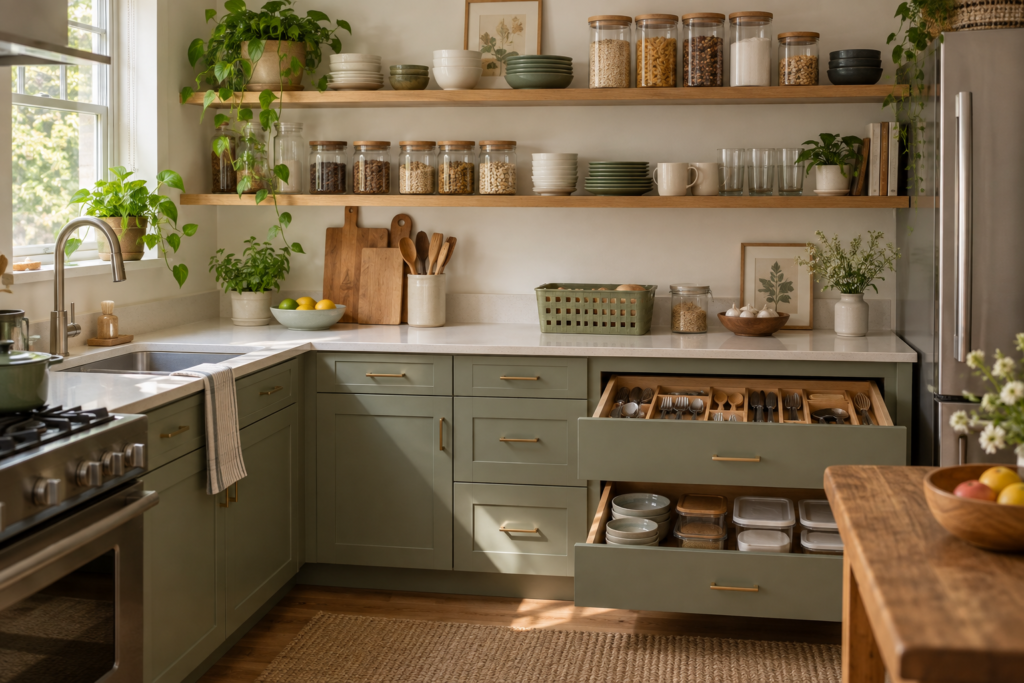
For spice storage options, a spice drawer insert is useful when it keeps labels visible within the drawer’s closing clearance. A stepped rack suits a cupboard with enough loaded height, a rotating tray can bring jars forward where turning space permits, and a removable bin works well for packets or grouped refills. Choose the format around your actual containers and storage location rather than an advertised jar count.
Spice organizers solve different access problems. Some create a better sightline, some bring the collection forward, and others divide it into clear groups. Choosing between them is easier when you know whether your main difficulty is hidden labels, awkward reach, mixed packets or an unreliable refill inventory.
This comparison explains those trade-offs without ranking untested products. It is intended for varied jar sizes and worldwide kitchens rather than one standardized container set. Start with the spice-storage setup guide if you have not yet sorted the collection. For a rack you already own, check common spice-storage problems before deciding it needs replacement.
Choose the location before the organizer
The location must suit the ingredients as well as the furniture. McCormick advises a cool, dry cupboard away from heat and moisture, including positions over a range or sink. Check the instructions on your own products when evaluating available spaces. An organizer cannot make every convenient spot appropriate for storing the collection. Source: McCormick FAQs.
Within suitable locations, compare how you see and handle the jars. A drawer may show tops clearly but hide front labels when containers stand upright. An upper cupboard may show front labels yet make the rear row difficult to reach. Measure and test from the position in which you normally cook, rather than evaluating the furniture only while it is empty.
Keep the active collection and refill collection distinct in your plan. You may choose one organizer for daily jars and a simple bin for unopened packets. Trying to make a single display contain every backup can increase its size without making cooking easier. The total system matters more than the elegance of one product.
Compare the main formats
| Format | Main benefit | Critical fit check | Common compromise |
|---|---|---|---|
| Angled drawer insert | Shows front labels in rows | Loaded height, jar length and row depth | May reserve more drawer area than standing jars |
| Upright drawer sections | Uses a simple footprint with top labels | Tallest jar through closing path | Needs readable lids and movement control |
| Stepped cupboard rack | Raises rear labels into view | Tall jars on the upper step | Can reduce lifting clearance |
| Rotating tray | Brings rear positions forward | Full turning area and loaded height | Round footprint may leave unused corners |
| Removable bin | Groups packets or refills | Grip space and manageable contents | Small items can hide in deep bins |
Angled drawer inserts
An angled insert presents jars in sloping rows so their front labels can be read from above. It can make a varied collection easier to scan, especially when the jars have useful original labels. The relevant measurement is the loaded arrangement: insert height plus the angle and diameter of the jars, not the empty insert alone.
Check the length of tall jars and grinders. A row designed around short jars may not support a longer container in the intended way. Wide jars can also change how many positions are genuinely usable. Do not translate a listing’s jar count directly into your own capacity unless the dimensions match your collection.
Consider how much of the drawer you want to dedicate to spices. An angled arrangement may use more area than upright jars, but improved visibility can justify that trade-off. Compare the routine rather than assuming the densest layout is best. If every jar is identifiable and easy to return, a slightly larger footprint may be useful space rather than wasted space.
Upright drawer storage
Standing jars upright can provide a compact arrangement when the drawer is tall enough and the tops are easy to identify. It works particularly well when labels on lids carry complete names, including distinctions between whole and ground ingredients. Without those labels, you may need to lift each jar to inspect the front, undermining the benefit.
Measure the full closing path. Some drawers have less usable height at the cabinet opening than their side walls suggest. Tall grinders and projecting caps need individual checks. Close a loaded sample gently and make sure jars do not tilt into the mechanism or strike the furniture during ordinary movement.
Dividers or a suitable liner may help control movement, but they should not create a tightly packed grid that makes jars hard to grip. Leave working room around wider containers. A few broad sections can be easier to maintain than exact positions for every jar, particularly when packaging sizes change between purchases.
Stepped racks for cupboards
A stepped rack elevates rear rows to improve visibility. It is useful when the shelf has enough height and the jars are reasonably compatible with the step depths. Check the tallest jar on the highest level and the space needed to lift it out. A visible label is not enough if the jar is trapped under the shelf above.
Inspect the usable depth of each step. A wide container may project beyond its support or prevent the next row from sitting properly. Product photographs often use consistent jars, so look for actual dimensions rather than assuming a mixed collection will arrange itself the same way. Include packets and grinders in your plan rather than leaving them to occupy random gaps.
For a shallow cupboard, a single visible row may work better than several levels. A stepped rack is most useful when it resolves a genuine sightline problem without adding a new clearance problem. The shelf-riser comparison explains similar trade-offs between extra levels and practical access.
Rotating trays
A rotating tray brings different parts of a collection to the front. It can help in a suitable cupboard where reaching the rear is awkward, but its circular footprint behaves differently from a rectangular shelf. Corners may remain unused, and objects projecting beyond the tray can collide with cabinet walls or neighbours as it turns.
Measure the complete turning area with the largest intended containers in mind. Check the loaded height as well, especially for a two-level design. The upper level may hide labels or restrict the space available for tall jars below. A tray that rotates freely when empty may not do so after varied containers are added.
Keep the arrangement readable as it moves. Several dense rings of jars can recreate the same hidden-row problem you were trying to solve. A smaller, clearly identified collection may make better use of the format. If the main issue is refill inventory, a labeled bin can be simpler than rotating all unopened extras through the cooking zone.
Removable bins and packet organizers
Bins are useful for packets, baking groups or unopened refills that do not need individual display positions. A removable group can be brought to the preparation area and returned as a unit. Choose a size that remains comfortable to grip and handle when stocked, with enough space around it to remove it without shifting unrelated items.
Shallow bins make small packets easier to scan. Tall narrow containers may keep packets upright, but check whether the labels remain visible and whether opening one packet disturbs the rest. A category label on the front helps other household members return items without guessing which bin belongs to which group.
For refills, the bin’s boundary can prevent unlimited accumulation. Pair it with a simple inventory check before shopping. A bin alone does not solve duplicate buying if no one looks inside it. Choose a system whose information is easy to maintain rather than a container large enough to hide the problem for longer.
Wall and door racks
A wall or door rack can release shelf space, but it introduces mounting and clearance requirements. Confirm the fixing method, suitable surface and permitted loading in the manufacturer’s instructions. For cabinet doors, check the loaded depth against internal shelves and stored containers before deciding the location works.
Consider movement. Jars may need a retaining feature appropriate to the rack’s intended use, and the loaded arrangement should not interfere with normal door operation. Do not infer suitability from an empty rack hanging neatly in a photograph. Measure your selected jars and the space through which the door moves.
Also evaluate the room conditions at the proposed position. An attractive wall display may receive sunlight, heat or moisture that a nearby closed cupboard avoids. Storage conditions and the product’s own guidance remain part of the decision. Display value should not be the only criterion for choosing a spice location.
Original packaging versus matching containers
An organizer that accepts the containers you already own can avoid a separate decanting project. Original packaging retains product identity and other information, while varied shapes may require more flexible sections. This is a reasonable trade-off when the collection changes or includes ingredients bought in different quantities.
Matching containers can simplify dimensions, but they add costs and a record-keeping task. If you transfer ingredients, preserve the identity, ingredient information, relevant dates and storage instructions. Measure the amount normally purchased so the new jar does not leave a recurring remainder that needs another storage system behind the display.
Do not buy containers solely because they fit an organizer you have not yet tested. Begin with a practical layout, then decide whether changing packaging provides enough benefit to justify the work. A clear label and one suitable bin may solve the original problem more directly.
A worked buying decision
Imagine a kitchen with twenty active jars, three tall grinders and six refill packets. The available drawer can accommodate the short jars but not the grinders standing upright. A nearby cupboard has enough height for grinders but its depth hides small jars behind them. Neither space serves the whole collection equally well.
One workable plan uses a drawer insert for the twenty daily jars, a clearly identified cupboard position for the grinders, and a refill bin with a short inventory note. Another uses shallow removable trays in the cupboard and leaves the drawer for utensils. The choice depends on which arrangement supports the household’s actual cooking and return routine.
To compare products, record the dimensions required by the chosen plan. Do not buy a large rotating system merely because its claimed capacity includes thirty jars. If the real need is readable labels in a low drawer, the rotating system addresses a different problem. The useful purchase is the one that fits the tested task.
Build a shortlist with verifiable information
For each candidate, note the overall size, useful internal dimensions, loaded clearance and any mounting requirements. Confirm the exact variant available from the retailer in your country. Prices and delivery terms vary, and similar photographs may appear across multiple sizes. Match the specifications to the selected item before ordering.
Read product descriptions for the limitations as carefully as the benefits. A rack may be intended for particular jar dimensions, a divider may need a minimum drawer width, or a tray may require additional turning space. Missing information is a reason to ask the seller or choose a better-documented alternative, not an invitation to estimate from an image.
Questions about spice storage
Which organizer stores the most spices?
Capacity depends on your jar shapes and the space available, so advertised counts are not directly comparable. More importantly, every jar should remain identifiable and retrievable. A smaller arrangement with clear access can serve cooking better than a crowded high-capacity rack.
Are rotating trays good for square cupboards?
They can be useful when rotation improves access, but the round footprint may leave corners unused. Measure the loaded turning area and compare it with a removable rectangular tray. The better choice depends on reach and visibility, not cupboard shape alone.
Should I buy an organizer before sorting spices?
Sort first. Confirm the active collection, separate refills and measure unusual jars. Otherwise you may buy around duplicates or occasional ingredients that do not need prime space. The organizer should fit a defined collection and a clear routine.
Is a two-tier rack always better than one tier?
No. The extra level needs enough loaded height and may obscure labels or restrict tall jars below. Check each level’s access separately. One readable row can be more useful than two levels that require frequent rearranging.
What should I test after delivery?
Check the dimensions and selected variant, assemble or mount it as instructed, and try the actual collection. Test finding, removing and returning jars, plus any drawer or door movement. Keep the packaging and order details until you know the organizer fits the full collection, including unusual jars that were in use during your first test. Also check the arrangement with several positions empty: jars should not become difficult to identify or return simply because you are using part of the collection. For related layout choices, visit the kitchen and pantry hub.
For the wider room layout, explore our small kitchen ideas and keep cabinet access, preparation surfaces and this storage area working together.