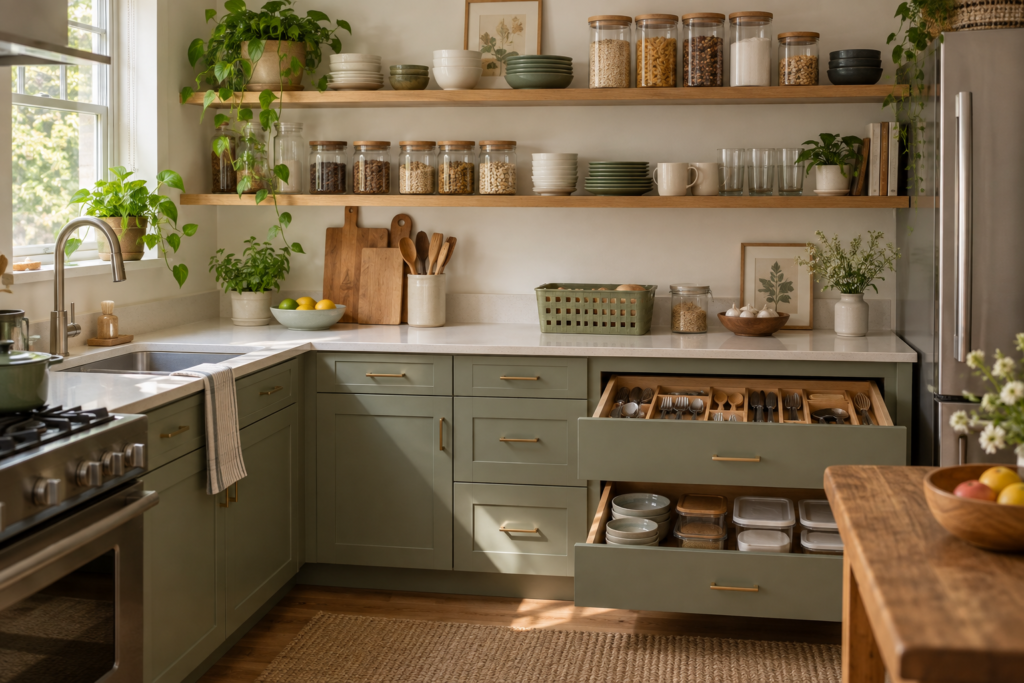
Set up spice storage by gathering the collection, separating duplicates and refills, and choosing a location where labels are easy to read. Group the jars in a way that matches your cooking, reserve a defined place for unopened extras, and keep the everyday selection easy to return. Choose the organizer after measuring the jars and the available drawer or cupboard.
Spice storage has two jobs: helping you find the ingredient you need and keeping a reliable record of what you own. A beautiful row of matching jars can still fail at both if the labels face the wrong way, original information disappears during decanting, or a second collection of refill packets grows somewhere else. Start with identification and use rather than a matching-container purchase.
This guide builds a practical system for a mixed household collection. You can apply it to a small selection of daily seasonings or a broader range used across different cuisines. It does not require buying every spice in advance or transferring ingredients out of useful original packaging. The wider kitchen and pantry guides can help you choose a location alongside other cooking supplies.
Gather jars, packets and refills into one inventory
Look in the everyday cupboard, baking area, pantry shelf and any basket of unopened packets. Write down what each item actually is, including whether it is ground, whole or a blend. Ground cumin and cumin seeds may share a name in casual conversation, but they are distinct ingredients and should not become one inventory entry.
Separate open containers from unopened refills. This makes duplicate purchases visible without encouraging you to pour everything together. Keep original product information available, including ingredient lists and the maker’s storage guidance. Blends with similar names can contain different ingredients, so a generic replacement label may not preserve the information a household member needs.
Create a temporary group for items you cannot identify confidently. Do not guess from colour alone or assign a familiar name because it seems likely. An unlabeled reddish powder is not a useful addition to an otherwise clear system. Resolve its identity from reliable packaging information before returning it to the cooking collection.
Choose a suitable location before choosing a rack
Spice maker McCormick advises storing spices in a cool, dry cupboard away from heat and moisture, including the areas over a range or sink. Use that guidance, together with the instructions on your own products, when evaluating a location. A convenient shelf beside rising cooking steam is not automatically a good home for the collection. Source: McCormick storage FAQs.
Now consider the practical route from storage to preparation. You should be able to take out the required jar, measure the ingredient and return the closed container without crossing a crowded kitchen. A drawer near the preparation area may work better than a display directly beside the hob. Evaluate your particular layout rather than copying the location shown in an organizer photograph.
Check who needs to use the spices. A high shelf that is convenient for one person may hide labels from another. Test the sightline from each regular cook’s usual position. The best location combines appropriate storage conditions with clear identification and comfortable access; it does not prioritize any one of those in isolation.
Pick a sorting rule that survives everyday use
Alphabetical order works well when people know the ingredient’s name and the collection contains many individual spices. Cooking-group order can suit households that repeatedly use a few combinations, such as baking ingredients or a small set of everyday savoury seasonings. The challenge is ambiguity: one spice may belong to several cooking groups.
Use a primary rule and keep exceptions limited. For example, you might maintain an alphabetical main collection plus a small tray of frequently used items. Avoid creating overlapping groups in several locations without an inventory, because that makes duplicate buying more likely. A spice should have one clear home even when it features in many recipes.
Whole and ground versions can sit beside each other with fully written labels. Do not rely only on lid colour or jar size to distinguish them, especially after brands or packaging change. Clarity matters more than fitting every label onto a single line. A readable two-line label is preferable to a short but ambiguous name.
| Rule | Good fit | Possible difficulty |
|---|---|---|
| Alphabetical | A varied collection shared by several cooks | New jars need a position in the sequence |
| Cooking groups | A few repeated recipes or clearly separate baking supplies | Some spices belong to multiple groups |
| Frequency of use | A small everyday selection plus occasional ingredients | Habits change and the front group can grow |
| One family per removable tray | Deep cupboards or packet collections | Trays need clear labels and comfortable removal space |
Keep original jars unless decanting solves a real problem
Original jars already carry useful product information and may fit your space well. If the main issue is visibility, lid labels or a different orientation can be enough. There is no organizational requirement to replace varied packaging with identical glass containers. Matching jars introduce additional purchasing, filling and record-keeping work.
Decanting can be useful when a verified food-storage container suits your ingredients and improves a specific layout. Before transferring anything, plan how you will retain the product identity, ingredients, relevant dates and storage instructions. Do not mix unidentified remnants or assume that a new label can stand in for information you have not recorded.
Also measure the amount you normally buy. A decorative jar that holds only part of a packet creates a second storage problem for the remainder. If the leftover packet needs its own container and inventory entry, the supposed simplification may not be worthwhile. Compare the whole routine, including refilling, not just the appearance of the front row.
Set up a drawer so labels stay visible
Measure the drawer’s internal footprint and closing clearance, then test your tallest and widest jars. Lying jars on an angled insert can make front labels easier to scan, while standing them upright can work if lid labels remain readable and the drawer is tall enough. Neither orientation is suitable for every package shape.
Place a small sample in the intended position and open and close the drawer gently. Notice whether the jars roll, bump into one another or shift out of their categories. An insert or shallow divider may help, but choose one that accommodates the actual mix of jar diameters rather than assuming all spice packaging is standardized.
Leave enough room to grip a jar without lifting its neighbours. A tightly packed drawer can look efficient while slowing every retrieval. Include the wider jars and tall grinders in the plan instead of treating them as afterthoughts. For more on the drawer itself, see the drawer-divider setup guide.
Set up a cupboard for readable rows
In a cupboard, the rear jars often disappear behind the front row. A shallow stepped organizer can improve visibility if the added height still allows labels to be read and jars to be lifted out. Check the loaded height, not just the bare rack. A tall jar on the upper step may collide with the shelf above.
A removable tray offers a different approach: bring the relevant group forward instead of elevating it. This can work for packets or a broad collection in a deep cupboard. Keep the tray manageable, with enough room to grip it and set it down. An oversized tray loaded with the entire collection may be awkward to handle.
For a narrow shelf, one clearly visible row may be more useful than a multi-level display. Store unopened refills elsewhere in the same general kitchen system rather than letting them hide active jars. The shelf-riser guide explains the importance of working clearance when adding levels inside a cupboard.
Give refill packets a separate, finite place
Choose a specific bin or section for unopened extras and partly used refill packaging. Label it clearly and keep an inventory simple enough to maintain. A note on the inside of the cupboard or a brief phone list can work; the format matters less than remembering to check it before buying another packet.
Keep different products identifiable in their own appropriate packaging. Do not combine several nearly empty packets merely to reduce visual clutter. If you transfer an ingredient, preserve the information needed to know what it is and how it should be stored. The refill zone should support the main collection, not become an unreviewed second pantry.
Set a quantity boundary that fits your cooking and shopping habits. Buying a large packet may be sensible for a frequently used ingredient, but it also requires suitable storage and a realistic plan to use it. A bargain that creates repeated overflow can make the daily system harder to maintain.
A worked setup for a mixed jar-and-packet collection
Imagine a household with eighteen active jars, six unopened refill packets and four spices used mainly for baking. The existing shelf has three deep rows, so the same front jars are easy to find while the back row is frequently forgotten. New packets are bought because no one remembers the unopened extras.
The revised layout puts the eighteen active jars into two readable groups in a nearby suitable drawer. Whole and ground versions sit together with full names visible. The four baking ingredients stay in a clearly labeled tray beside other baking supplies because that is where they are consistently used. A small refill bin contains the six unopened packets.
Before the next shop, the household checks the refill bin against its short list. During cooking, jars return to the same visible positions. The result is not a larger collection or a more elaborate display. It is a clearer link between what is used, what is stored as backup and what actually needs replacing.
Make the system easy to maintain
Return jars with their identifying label facing the viewing direction. This small action is more useful than periodically rebuilding a display after every label has turned away. If the arrangement requires exact spacing to remain readable, loosen it or use broader sections. A busy kitchen needs a little tolerance.
Review the collection when a jar is finished or when you plan a shopping list. Remove obsolete inventory entries and check whether the empty container’s role is still needed before automatically refilling it. A spice bought for one unsuccessful recipe does not have to become a permanent fixture in the prime cooking zone.
Choose any new organizer around the proven trial. Record the jar diameters, loaded height and number of useful positions. Look for specifications that explain the actual space available rather than a broad promise to hold a certain number of jars. Capacity depends on the jars you own and the way you need to identify them.
Rehearse a recipe before calling the setup finished
Choose a familiar recipe that uses several ingredients from different parts of the collection. Gather those jars in the order you would normally need them, then put them back after measuring. Notice whether the label, opening direction or container shape makes any step awkward. A drawer that looks organized while untouched may behave differently when several gaps appear at once.
Next, ask another household member to find the same ingredients using only the visible labels and category rules. Do not coach them through the arrangement. If they hesitate between two similarly named products, improve that distinction. If they cannot tell where a jar belongs, simplify its category. This small rehearsal is more informative than rearranging everything to make the rows symmetrical.
Finally, check the refill record for one ingredient that is nearly finished. The complete system should support cooking, returning and shopping. When those three actions work without searching through hidden packaging, the layout has earned its place in the kitchen.
Questions about spice storage
Do I need matching spice jars?
No. Keep original packaging when it works and preserves useful information. Matching jars are a layout choice, not a requirement for organization. If you decant, use suitable containers and retain the product identity, relevant dates, ingredients and storage guidance.
Should spices be alphabetical?
Alphabetical order is useful for a varied shared collection, but a clear cooking-group system can also work. Choose the rule people naturally use to find ingredients. Avoid overlapping categories that leave one jar with several possible homes.
Where should large refill packets go?
Give them a defined, suitable backup zone with clear identification. Check that zone before shopping. Keep the active jar easy to find and avoid letting unopened extras take over the front row of daily storage.
Is a drawer better than a cupboard?
It depends on the available location, jar sizes and sightlines. A drawer can show lid labels well; a cupboard can suit taller containers or removable trays. Test the complete loaded arrangement and follow the products’ storage instructions.
How many spices should fit in the everyday zone?
Enough for the ingredients you regularly use, with comfortable identification and retrieval. There is no universal ideal count. Separate backups and occasional supplies when they obstruct the daily routine, then adjust the collection as your cooking changes.
For the wider room layout, explore our small kitchen ideas and keep cabinet access, preparation surfaces and this storage area working together.