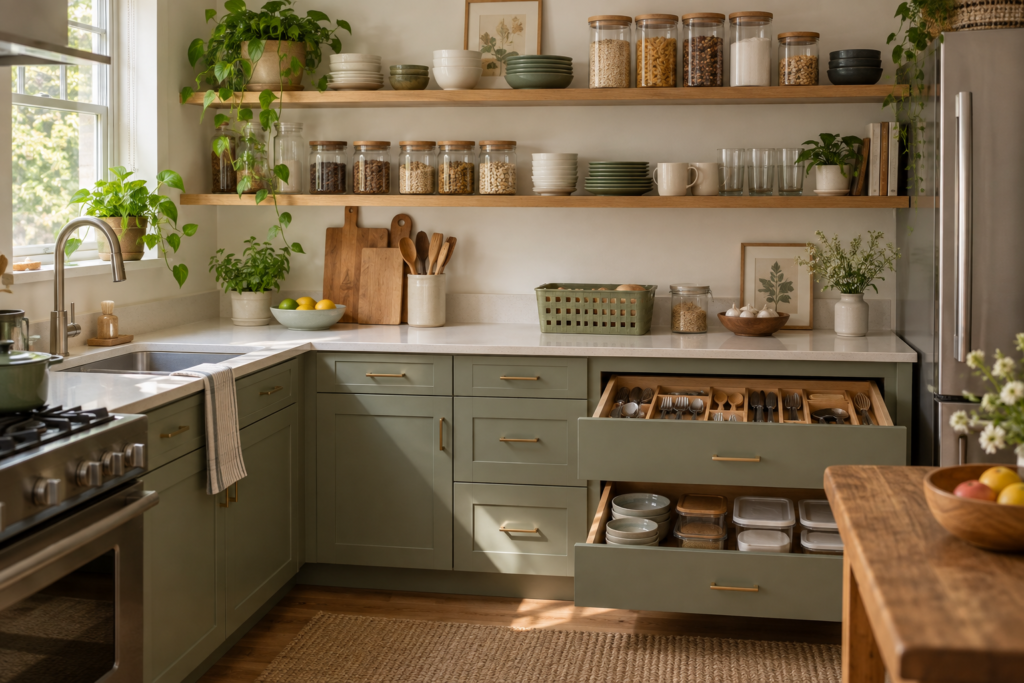
For spice storage problems, fix spice-storage problems by separating identification, access and inventory issues. Turn labels toward the viewing direction, reduce hidden rows, keep unopened refills in a defined zone, and use one clear sorting rule. If the location exposes the collection to unsuitable conditions, move it before investing in a new rack.
Spice storage often fails gradually. A new jar arrives without a place, a refill packet slips behind the collection, and a familiar seasoning is purchased twice because neither cook can see the original. The cupboard may still close, but the system no longer gives reliable answers to “Where is it?” and “Do we need more?”
This guide focuses on those recurring faults. It does not prescribe a fixed number of spices or a uniform set of jars. Use the spice-storage setup guide if you need a complete starting arrangement. Here, begin with the particular symptom that keeps returning and change only the part of the routine responsible for it.
Decide whether the problem is finding, reaching or tracking
Finding means you cannot identify the correct ingredient quickly. Reaching means you can see it but cannot remove it comfortably. Tracking means you do not know how much you already own or whether a refill exists. One organizer can improve the first problem while doing little for the other two, so name the fault before shopping.
Watch a normal cooking task. Count the jars moved before the desired one appears, then observe what happens when it is returned. If the label is hidden again immediately, changing the sorting order will not solve the sightline problem. If the jar is easy to see but the cap hits the shelf above, the issue is working clearance.
Repeat the check while making a shopping list. If you need to empty the cupboard to discover backups, the refill system is not providing a useful overview. A small inventory note or a separate visible bin may help more than a larger display for the active jars.
| Recurring problem | Check | Useful first change |
|---|---|---|
| Back-row jars disappear | Depth and label sightline | Reduce rows or bring a group forward in a tray |
| Duplicate packets accumulate | Whether refills have one known location | Create a separate inventory zone |
| Similar names are confused | Whole, ground and blend labels | Write complete product names |
| Jars catch under a shelf | Loaded organizer height | Lower the level or change the jar assignment |
| Spices migrate to the worktop | Difficulty of returning them | Simplify the destination and remove crowding |
Jars disappear behind the front row
Deep rows use shelf area efficiently on paper but make labels hard to see. Start by pulling all active jars into view and noting how many rows you have created. If finding one ingredient requires lifting two others, the depth is doing more work for capacity than for convenience.
A stepped rack can improve the sightline, but check the height of the tallest jar on the highest step. The organizer may create a visible label while leaving too little room to lift the jar. Test a loaded sample rather than relying on the empty rack’s dimensions. A lower step or a different shelf may be necessary.
A removable tray is another option, particularly for packets or less frequently used groups. It brings the collection forward without requiring additional vertical space. Keep the group small enough to handle comfortably and leave room to grip the tray. Replacing hidden rows with an unmanageable full-cupboard tray merely changes the obstruction.
Labels are readable only after you pick up the jar
The label must face the direction from which you view the collection. In a standing drawer arrangement, that often means identifying the contents on the top. On a shelf, the front label matters more. Applying labels without considering the normal viewing angle can produce an orderly-looking system that still requires repeated handling.
Use complete names where distinctions matter. “Cumin” may not distinguish ground cumin from cumin seeds, and “chilli” may refer to several different products. Keep blends identifiable by their actual name and preserve ingredient information. Do not let a short decorative label replace information needed for correct selection.
If labels turn away during use, provide enough room to return each jar easily and make the facing direction obvious. A crowded rack encourages people to drop jars into the first available gap. Improving the return space can solve the apparent labeling problem without printing an entirely new set of labels.
You keep buying ingredients you already own
Duplicate buying often reflects an inventory split between active jars and hidden refills. Gather unopened packets into one defined zone and make that zone part of the shopping routine. The aim is not to display every backup beside the daily jar, but to make checking backups quick and predictable.
Use a simple list if packaging is difficult to scan. Record the ingredient and whether a spare exists, then update the note when the refill is opened. Avoid a detailed tracking system that requires more attention than the household will give it. A short accurate list is more useful than a sophisticated inventory abandoned after a week.
Distinguish a duplicate from a legitimately different product. Whole spices, ground versions and blends may serve different recipes. The inventory should preserve those distinctions. Combining them under one broad name can cause the opposite problem: assuming an ingredient is available when the required form is missing.
Decanting has created a second clutter zone
Matching jars can simplify a display while multiplying the containers behind it. If a packet does not fit into the chosen jar, the remainder needs an identifiable and suitable storage location. When several such packets accumulate, the original packaging has not disappeared; it has become a less visible collection that also needs managing.
Assess whether decanting is solving a real access problem. Keeping an original jar may preserve information and avoid the refill step. For ingredients bought in larger quantities, choose a routine that acknowledges the separate backup rather than trying to hide it. A clear refill bin and retained packaging information can make that arrangement understandable.
Do not combine unidentified remnants or replace missing product information with a guess. Preserve identity, ingredients, relevant dates and storage instructions when transferring a product. If those records are difficult to maintain, returning to suitable original packaging for future purchases may be the simpler organizational choice.
The rack is convenient but the location is unsuitable
McCormick recommends a cool, dry cupboard away from heat and moisture, including areas over a range or sink. Review your own product instructions and the actual conditions around the storage spot. A rack placed where cooking steam regularly reaches it may need relocation rather than a different sorting method. Source: McCormick FAQs.
Look for a nearby alternative that still supports preparation. Moving the collection does not have to mean sending it to the opposite end of the home. A suitable drawer near the work area or a cabinet section away from the immediate cooking zone may maintain convenience while giving the spices a more appropriate location.
Avoid treating a decorative container as a cure for an unsuitable position. The container’s specifications and the ingredient’s instructions both matter. This guide cannot infer preservation performance from appearance, so do not assume a matching jar set makes every shelf location appropriate.
The organizer fits the cupboard but not the jars
An advertised capacity usually assumes particular jar sizes and shapes. Your tall grinders, wide jars and packets may use the space differently. Lay out the actual collection and measure the pieces that do not fit. The solution may be a separate position for one unusual category rather than a larger organizer for everything.
For a drawer insert, check whether wide jars sit securely and whether long jars extend beyond the supported area. For a stepped rack, inspect shelf depth and loaded height. For a rotating tray, consider the complete turning area, including anything that projects beyond the tray’s edge. Different formats fail in different ways.
Do not force all containers into a matching pattern. Keeping one tall grinder beside the main group can be more convenient than sacrificing an entire row to accommodate it. The shelf-riser troubleshooting guide explains similar conflicts between organizer dimensions and real retrieval space.
Spices keep collecting on the worktop
If jars are routinely left out after cooking, examine the return action. A destination behind a heavy tray, an overfilled rack or a cupboard requiring several rearrangements makes the correct action inconvenient. Clear the route and reduce the precision needed to put one jar back.
An everyday tray can be useful when a small group genuinely travels together during preparation, but give it a defined home afterward. Without a boundary, the tray may expand into a permanent collection of unrelated ingredients and utensils. The aim is to support a repeated task, not to create another overflow area.
Ask each regular cook to return a few jars without instruction. If people disagree about where they belong, the sorting rule needs clarification. Alphabetical order or a small number of clearly named groups is often easier to share than categories based on one person’s private association with a recipe.
A worked repair for repeated duplicate purchases
Imagine a household with twenty-four jars in a deep cupboard and eight refill packets distributed between two shelves. The main complaint is that the spice rack seems too small. During a quick inventory, the household discovers three unopened duplicates and several jars hidden behind tall grinders.
The repair has two parts. First, the active jars move into a shallower visible arrangement, with tall grinders beside rather than in front of them. Second, all refills receive one labeled bin and a short inventory note. The household checks that note while planning groceries, then verifies the relevant packet before buying.
The collection now uses roughly the same ingredients but provides better information. Buying a wider rack alone would not have solved the duplicate-purchase problem because the refills would still have been scattered. This distinction is worth making before spending money on an organizer that addresses only the visible symptom.
After the next shopping trip, check whether incoming packets actually reach the new refill bin. If they are left in a grocery bag or another cupboard, improve that arrival step. Put the inventory note where shopping decisions happen and make the bin easy to access during unpacking. A storage repair becomes durable when new items enter correctly as well as when existing jars are arranged neatly. Review the routine once more when the first active jar is emptied and replaced from a backup.
Decide when to replace the organizer
Replace an organizer when its fixed dimensions repeatedly conflict with the collection after sensible reassignment. A rack with inadequate shelf depth cannot become suitable for wide jars through labeling. A drawer insert that exceeds closing clearance needs a different location or profile. These are structural fit problems rather than household discipline problems.
Before buying, write down the successful parts of your trial and the remaining failure. Compare internal dimensions, loaded height, grip space and cleaning access. Check the actual variant sold in your market and avoid relying on photographs of a different size. A precise requirement narrows the shortlist far better than a promise of maximum capacity.
Questions about spice storage
Why does alphabetical order keep breaking down?
The collection may be too crowded, labels may be hard to see, or the return location may be ambiguous. Fix those physical problems before enforcing the sequence. Alphabetical order works best when each jar can be returned without moving several others.
If the problem starts whenever a new spice arrives, reserve some flexible space within the arrangement. A rigid rack filled to its last position cannot absorb additions without moving several jars. You might keep broad alphabetical sections instead of one exact slot per ingredient, or review an occasional item before expanding the active collection. The choice should make change manageable rather than treating every new purchase as a failure of the entire system.
Should I put refills behind the matching jar?
That can work if the backup remains visible and does not block access, but hidden refills are easy to forget. A separate clearly identified zone may be easier to check before shopping. Choose the method that gives your household a reliable inventory.
Are matching jars the answer to confusing labels?
Not necessarily. Clear, complete labels on useful original packaging may solve the problem with less work. Decanting adds a responsibility to preserve product information and manage leftover packets. Consider the whole routine before changing containers.
What if one spice belongs to several cooking groups?
Give it one permanent home and make that rule clear. Alternatively, use an alphabetical main collection with a small temporary preparation tray. Multiple permanent homes for the same ingredient make stock tracking harder.
How can I tell whether the repair worked?
Test both cooking and shopping. You should find and return the correct jar without dismantling the arrangement, then check for refills without emptying the cupboard. Continue through the kitchen organization hub if neighbouring storage is limiting the available space.
For the wider room layout, explore our small kitchen ideas and keep cabinet access, preparation surfaces and this storage area working together.