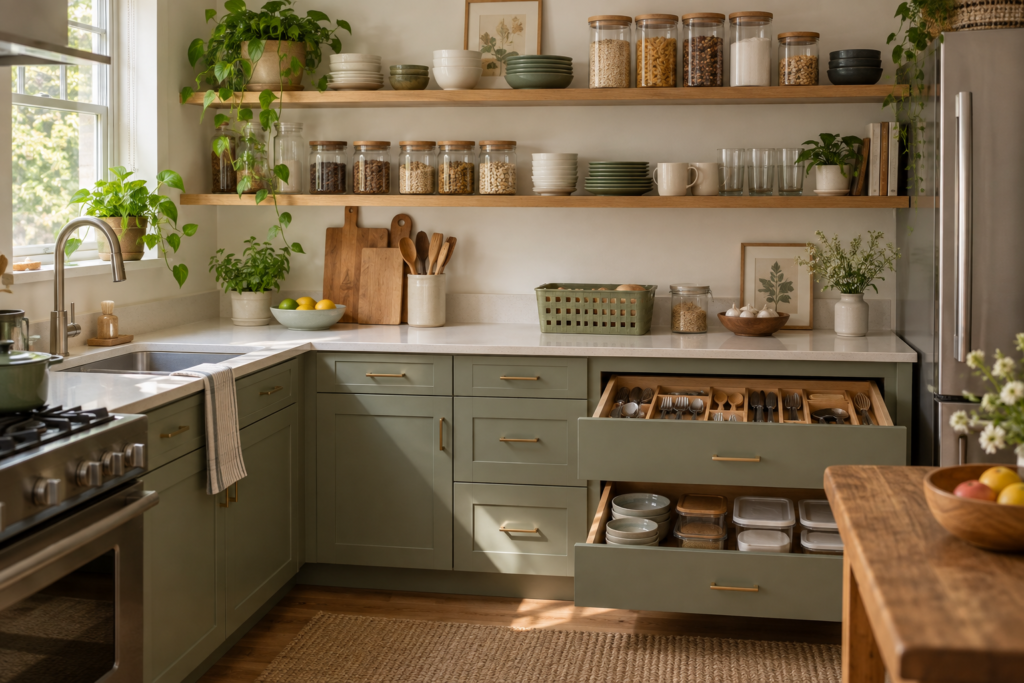
For pantry-free food storage problems, most small-kitchen food-storage problems come from hidden stock, containers that do not match package sizes, or a layout that works only before grocery shopping. Find the repeated point of friction first. Change one location, quantity, or container at a time, then test the change through a full shopping and cooking cycle.
A kitchen without a pantry does not need constant reorganization. If you are repeatedly emptying cupboards to find ingredients, the problem is usually specific enough to diagnose. Perhaps breakfast packets collapse behind tall bottles. Perhaps a new bag of flour leaves an awkward remainder outside its container. Perhaps the reserve shelf is so separate that nobody remembers to check it.
This guide is for fixing an existing system. If you are starting with an empty cupboard, use our step-by-step pantry-free food storage setup first. Here, the aim is to identify what actually fails during daily use and make a targeted change. You do not need to replace every organizer or decant every ingredient to make progress.
Diagnose the failure before moving everything
Watch one ordinary meal preparation and one grocery unpacking session. Write down the moments when you move an unrelated item, leave something on the counter, open a duplicate, or cannot find a known ingredient. Those observations are more useful than judging whether the cupboard looks tidy with its doors open. A visually uniform arrangement can still demand too many steps.
Choose the problem that happens most often. For example, “I cannot see the rice behind the cereal” suggests a visibility issue. “There is nowhere to put a new bag of rice” suggests a capacity or refill issue. These sound similar but need different fixes. A clear bin could improve visibility while doing nothing about the oversized package.
| Symptom | Likely issue to investigate | First change to test |
|---|---|---|
| You buy duplicates | Opened food and reserves are hard to see | Create one visible check-before-shopping area |
| Packets fall behind jars | Different shapes share an unsupported row | Group small packets in a shallow removable bin |
| Food remains on the counter | Its assigned home is full or awkward | Test putting it away with the cupboard fully stocked |
| A drawer jams | Contents exceed closing clearance | Check the tallest lid, handle, or packet |
| A container leaves a remainder | Capacity mismatches the package | Compare a different size with keeping original packaging |
| One person continually resets everything | Categories are unclear or overly complicated | Ask another person to put away groceries unaided |
Problem 1: ingredients disappear at the back
Deep shelves create two different issues: visibility and retrieval. You may be able to see a tall bottle at the back but still need to remove five items to reach it. Conversely, a low packet may be easy to reach once located but impossible to notice from the front. Identify which problem applies before adding a riser or a bin.
Fix poor visibility with shorter rows
Put opened items where their names are visible and keep appropriate duplicates together behind them. Avoid a front row of tall unrelated packages that conceals several categories. Where the shelf allows it, arrange tall items to one side and shorter items in a separate row. Do not assume that every centimetre of depth must hold a separate loose item.
A shallow bin can gather flexible packets into a single visible group. Choose a depth that lets you inspect the contents without unloading them. An opaque deep box labelled “food” merely relocates the hiding problem. A specific label such as “baking packets” works better because it tells you what to expect and limits what belongs there.
Fix poor retrieval with a removable group
If rear ingredients are visible but difficult to reach, trial a suitable removable bin. Put the relevant group inside and practise taking it out with the real contents. The loaded bin must pass the door frame, remain manageable to lift, and have somewhere safe to rest while you choose an ingredient. A large container can make retrieval harder if it is too heavy.
For a shelf riser, test both levels independently. If taking a tin from the lower level requires lifting the riser, the arrangement has traded one obstruction for another. Follow the product’s load instructions and leave enough clearance for your hand. A lower number of accessible items is often more useful than a tightly packed display.
Problem 2: the cupboard overflows after grocery shopping
An arrangement designed while supplies are nearly empty can fail immediately after a normal shop. Compare the cupboard at its fullest ordinary point with the quantities you expect to store. Include unopened replacements, multipacks, and ingredients bought for planned meals. Temporary surplus becomes permanent clutter when there is no defined reserve space.
Separate working stock from reserves
Keep the opened package in the everyday zone and unopened suitable replacements in a bounded reserve area. This can be another shelf or a suitable container elsewhere, but it needs a clear label and a routine check. Moving reserves out of sight without including them in the shopping check encourages duplicate purchases rather than solving them.
Set the reserve limit by space and use, not by the number of matching baskets you own. If one household uses rice often and baking supplies rarely, the reserve allocation should reflect that difference. Avoid assigning equal space to every category simply for symmetry. Review quantities when cooking habits change instead of treating the first layout as permanent.
Test whether the purchase quantity fits the home
A bulk package is not automatically useful if it creates several awkward storage locations or cannot be used according to its instructions. Before purchasing it, identify a suitable home for the entire amount. Compare the total cost and practical handling of the sizes available locally, but do not let a promotion determine a storage arrangement that repeatedly fails.
In a small kitchen, reducing one infrequently used reserve category may free enough space for a daily staple. Start there before buying furniture. Additional storage makes sense only when the location is suitable, the footprint does not obstruct normal use, and the furniture can be installed according to its instructions.
Problem 3: containers do not match the ingredients
Matching container sets often contain several capacities, but your shopping pattern may require repeated use of one size and none of another. Lay out the actual package sizes you buy. Note which ingredients fit completely, which leave a remainder, and which occupy only a small fraction of their container. Those mismatches point to the pieces worth changing.
When a new packet leaves an awkward remainder
Check the difference between volume and mass. A litre measurement on a container cannot be read as an equivalent kilogram capacity for every food. Ingredients differ in density and shape. Look for manufacturer information specific to the ingredient, or test a suitable existing container before buying. Leave practical room for the closure and the way you scoop or pour.
You have three realistic choices: choose a suitable larger container, buy a package size that better matches your storage and use, or keep the food in its original packaging inside a supporting bin. Keeping a separate remainder can work only if it has a clear location and is included in the refill routine. Otherwise you have doubled the number of places to check.
When decanting creates more work than it saves
Stop transferring ingredients that do not benefit from it. An original packet with an appropriate closure may be easier to identify and replace than a jar requiring a new label each time. Use food-storage containers for clear reasons, such as easier pouring or supporting an awkward bag, rather than treating decanting as a requirement for an organized kitchen.
When transferring food, use containers intended for the purpose and retain ingredient, allergen, preparation, date, and identification information. Follow the food and container instructions. Avoid continuously mixing new contents into old ones without a deliberate emptying and cleaning process. Organization should make the food easier to identify, not remove information you may need later.
Problem 4: bins, doors, and drawers are awkward
The bin fits on the shelf but will not come out
Measure the cupboard opening separately from the shelf interior. Hinges and a centre stile can reduce the route through which a container must pass. Handles may extend beyond the advertised base width. If you need to tip a bin sharply to remove it, ask whether that movement remains practical when it holds bottles or loose packages.
Trial a narrower container or divide the category into two smaller groups. This is particularly useful when a single large bin is difficult to lift. Do not remove furniture components or alter hinges simply to accommodate a storage purchase without understanding the furniture’s design. Choosing an appropriately sized organizer is usually the more straightforward adjustment.
The drawer catches when closing
Look for the tallest point, which may be a lid tab, a handle, or the folded top of a packet. Test the drawer slowly with the actual contents in their normal positions. If items tip during movement, use a suitable divider or a lower container to limit shifting. Check the drawer’s load rating before adding a dense row of tins or jars.
Top labels can make drawer contents easier to identify, but they must remain accurate when containers are refilled. Keep similar-looking ingredients distinct. If a drawer is too shallow for the upright containers you own, choose an appropriate different location or storage format instead of forcing the drawer closed.
Problem 5: nobody follows the categories
A household system fails when its categories make sense only to its designer. “Daily,” “extra,” and “other” may be too vague. “Breakfast,” “baking ingredients,” and “unopened reserves” communicate clearer jobs. Ask another person where they would put a new package without giving instructions. Their hesitation reveals where a label or boundary needs improvement.
Reduce decisions at the point of return
Place the most frequently handled category where it is easy to reach and leave enough space to return items without repacking. If putting away one bag requires aligning six containers, the layout demands too much precision. A slightly looser row or a flexible bin can be easier to maintain than a tightly fitted arrangement.
Keep category labels broad enough to survive normal brand changes while retaining exact information on transferred food. A bin can be labelled “breakfast” while the food inside remains clearly identified. Do not use decorative labels as a substitute for allergen or preparation information. The group label and the product label serve different purposes.
Make opened stock obvious
Use a consistent location for opened packages so people can check them before opening a replacement. This does not require a special organizer. A clear front section can work if everyone follows the same rule. Review whether that section is overloaded; when every item is designated “use first,” the label stops helping anyone prioritize.
Problem 6: the available location is unsuitable
Heat or dampness is a location problem, not a container-style problem. The USDA recommends cool, dry storage for shelf-stable foods and advises against locations such as above a stove or under a sink. Follow individual food instructions, including any requirement to refrigerate after opening. A sealed-looking box does not override them.
If the only spare cupboard is unsuitable, reassess how the kitchen’s other contents are allocated. Moving occasional cookware to a suitable different location may release a better cupboard for food. Use the whole-home reset guide to review those boundaries. Keep cleaning supplies in their own appropriate zone with help from our under-sink organization guide.
If you find damaged packaging, signs of pests, or unexplained moisture, investigate before returning food to the area. Follow appropriate local food-safety and pest-control guidance for the specific issue. This article does not determine whether a particular affected food is safe. Do not disguise a recurring problem with new baskets or perfume products.
When buying a new organizer is justified
Buy when you can identify a physical problem that the product’s verified features solve. For example, a narrow handled bin may make a defined packet group removable; a correctly sized divider may stop drawer contents shifting. Avoid shopping from a vague goal such as “make everything tidy,” because it gives you no reliable way to compare options.
- Write down the exact obstruction or handling problem.
- Measure the space and the removal route.
- Check external and internal dimensions separately.
- Confirm care requirements, installation, and rated capacity.
- Check the current listing in your country and the return conditions.
- Start with one piece and test it before buying a full set.
The comparisons in our storage buying guides focus on fit and use cases. A replacement purchase should reduce a repeated task or solve a clear access issue, rather than simply change the cupboard’s appearance.
Check the repair through one normal shopping cycle
Record the original problem in a short sentence, make one change, and use the cupboard normally. Count meaningful friction: how often you move another item, whether food remains on the counter, and whether duplicates are opened. You do not need a numerical score for the whole kitchen. You need to know whether the specific change improved the recurring problem.
After the next grocery shop, check the fuller layout again. A successful fix works both when stock is low and after replenishment. If it fails only at the fuller stage, review reserve quantities and space. If it fails every day, review access and category boundaries. This distinction helps prevent repeated purchases aimed at the wrong problem.
Questions about food storage without a pantry
Why do I keep buying food I already have?
Your opened ingredients and reserve stock may be hard to check together. Give reserves one defined location and check both zones before shopping. Keep labels visible and group duplicates. If an inventory list is not maintained, use a simple visual check rather than relying on an outdated record.
Will clear containers fix a crowded cupboard?
They may improve visibility, but they cannot create unlimited capacity or correct an unsuitable location. Compare their footprint with the original packaging, including lids and handles. A clear container is useful only if its size and closure suit the food and its normal handling.
What should I do when there is no room for reserves?
Review purchasing quantities and occasional ingredients first. If reserves remain necessary, identify another suitable, clearly labelled location and include it in your shopping check. Do not put food in a damp or hot space simply because it is empty.
How can I stop small packets falling over?
Group them in a shallow bin or a suitable divided drawer so they support one another without being tightly compressed. Keep the labels visible from the direction you normally look. Avoid a tall container that conceals the entire packet and requires unloading to identify it.
Should I reorganize everything when one shelf fails?
No. Diagnose that shelf first and change the smallest element that addresses the issue. A whole-cupboard reset makes sense when locations and quantities no longer match your household, but it is unnecessary when one oversized bin or unclear label causes the difficulty.