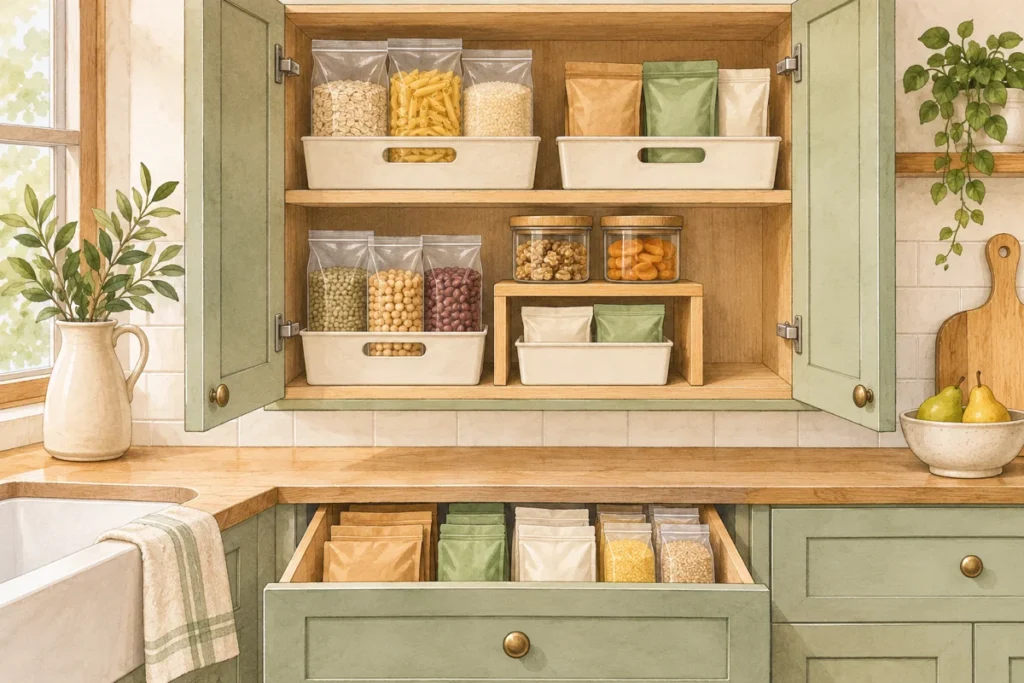
For pantry-free food storage options, use cupboard bins when packets need grouping, food-storage containers when original packaging is awkward, and shelf risers when short items leave usable height above them. A drawer system suits top-down access. A freestanding cabinet is worth considering only when existing suitable storage is genuinely insufficient and its footprint, installation, and location work for your home.
The best purchase is the smallest change that solves your actual food-storage problem. A complete matching container set may look appealing but leave you with the wrong capacities. A new cabinet may add shelves while making a narrow kitchen harder to move through. Compare storage by the job it must do before comparing colours, accessories, or promotional prices.
This guide compares formats and buying criteria rather than claiming that we have tested specific products. Dimensions, materials, and installation requirements vary by model and country. Check the exact listing and manufacturer instructions before purchasing. Our editorial policy explains how we distinguish planning advice from product reviews, and our affiliate disclosure describes the site’s commercial-link policy.
Start with the problem the product must solve
Write a single sentence describing the difficulty. Examples include “small packets disappear behind jars,” “the cereal bag will not close conveniently,” or “every suitable cupboard is full after our normal shop.” These statements point to different product categories. If the problem is still vague, use our pantry-free food storage troubleshooting guide before shopping.
| Storage format | Best suited to | Main trade-off | Skip or reconsider when |
|---|---|---|---|
| Open cupboard bin | Grouping packaged ingredients | Bin walls and handles use shelf space | The loaded bin is heavy or cannot pass the opening |
| Food-storage container | Improving closure, pouring, or support for loose food | Transferring and cleaning add work | The original package already works well |
| Shelf riser | Using spare height above short items | Clearance and access can become tighter | Both levels cannot be reached independently |
| Drawer divider | Keeping packets or containers upright in a drawer | Dividers consume internal width | The drawer is too shallow or overloaded |
| Freestanding cabinet | Adding a defined food-storage area | Needs floor space and safe installation | The location is hot, damp, or obstructs circulation |
| Rolling cart | A movable group of suitable packaged supplies | Movement and open shelves require careful placement | There is no stable parking location or clear travel route |
Before comparing any organizer, verify that the storage location suits the food. The USDA’s shelf-stable food guidance recommends a cool, dry place and cautions against locations such as above the stove and under the sink. Follow each package’s directions, including changes after opening. Furniture and containers do not make an unsuitable environment suitable.
Option 1: open cupboard bins
Open bins are useful for collecting several packaged items into a removable group. They can support flexible packets, separate breakfast from baking ingredients, and make a deep shelf easier to retrieve from. Because the food remains in its packaging, you also keep its identifying information with it. Start with one category whose current arrangement is difficult, rather than buying enough bins to cover every shelf.
Choose the shape around the opening
Measure the widest part of the bin, including handles and the rim, against the cupboard opening. Then compare its depth with the shelf and the space needed to pull it out. A container can sit comfortably inside a cupboard yet require awkward tilting to pass a hinge or centre frame. Test the loaded removal action where possible, not just the empty footprint.
A deep bin maximizes a category’s capacity but may hide small items behind one another. A shallow bin uses less depth but improves visibility. Choose according to the food shapes and the way you retrieve them. If you intend to bring the entire category onto the counter, make sure the loaded weight is comfortable and there is a practical landing space.
Clear versus opaque bins
Clear sides help you see packages from the front, while opaque bins depend more on labels and shallow grouping. Neither is automatically superior. Consider whether the shelf is above eye level, whether labels face the front, and whether the contents change often. A clearly labelled opaque breakfast bin can be more useful than a transparent container filled with unrelated ingredients.
Choose this format if: your food packaging works, but packets need support or grouping. Reconsider it if: the proposed bin is so large that removing it becomes harder than retrieving individual items. Two smaller bins may suit the opening and the household better than one large basket.
Option 2: containers for transferred food
Food-storage containers are worth considering when they improve a specific task: closing a frequently opened bag, pouring cereal, scooping an ingredient, or keeping an awkward package upright. Their value depends on the food and the container design. Decanting everything is not a prerequisite for an organized kitchen, and it introduces cleaning, labelling, and refilling work that someone must maintain.
Match capacity to the package
Compare the actual package size you buy with the manufacturer’s ingredient-specific guidance where available. Litres measure volume and kilograms measure mass; equal numbers do not imply equal capacity. Different foods take up different amounts of space. Also allow practical room for the lid mechanism and the way you remove food. A container filled to the brim may be inconvenient even when it technically holds the package.
Consider what happens on refill day. If every new packet leaves a small amount outside the container, you will need a second storage location for that remainder. A larger suitable container, a different purchase size, or keeping the original packaging may produce a simpler system. Judge the whole refill cycle rather than the appearance of the container immediately after filling.
Compare closures and cleaning requirements
Try to understand how the closure works during normal use. Does it require two hands? Can the lid be removed and replaced easily? Are seals removable for cleaning, and does the manufacturer explain how to clean and dry all parts? Follow the stated care instructions rather than assuming every clear container is dishwasher-safe or suitable for every food.
Use containers intended for the relevant food-contact purpose. Retain ingredient, allergen, date, preparation, and product-identification information when transferring contents. Avoid relying only on a decorative name label. Similar-looking powders and grains need accurate identification, and packaging information may be useful if a product is recalled or someone has a dietary requirement.
Evaluate individual sizes before a large set
A mixed-size set may offer a low price per piece but include sizes you rarely use. Count containers and lids carefully in the listing: a “piece” count can include both. Compare the number of usable containers in the capacities your household needs. Buying one suitable size first gives you a chance to test pouring, cleaning, and shelf fit before committing to the wider range.
Choose this format if: it improves handling or closure for a frequently used ingredient. Reconsider it if: transferring adds a second remainder package, loses useful information, or makes cleaning more complicated than the original packaging. A simple supporting bin may solve the problem with fewer steps.
Option 3: shelf risers and tiered organizers
A shelf riser creates another level above part of an existing shelf. It can be useful when short items leave substantial unused height, but the added platform, legs, and thickness also reduce clearance. Measure the tallest item intended for each level and include the space needed to take it out. The aim is two independently accessible groups, not one stack that must be dismantled.
Check the supports and usable platform
Look at where the legs land and whether they interfere with the items beneath. Compare the usable platform dimensions with the overall footprint. If the design expands, confirm the permitted configurations and how capacity changes, if applicable. Use the manufacturer’s rated load and assembly instructions rather than estimating strength from the material’s appearance.
For a tiered organizer, check the depth of each step against the packages you intend to place on it. A narrow ledge that suits small jars may not support larger tins well. The rear tier must also leave sufficient clearance below the shelf above. A photograph showing short sample jars is not evidence that your taller packages will fit.
Choose this format if: you have usable spare height and small items that benefit from visible levels. Reconsider it if: the lower level becomes difficult to reach or the support legs consume the space you hoped to gain. Repositioning an adjustable cupboard shelf may be worth considering first, where the furniture’s design permits it.
Option 4: drawer dividers and shallow trays
Drawers provide a top-down view, which can be excellent for small packages and labelled container lids. Dividers help limit shifting and define categories. Measure the interior width, depth, and closing clearance, including any fittings that project into the drawer. Confirm the furniture’s load capacity before concentrating dense tins or glass containers in one drawer.
Fixed compartments versus adjustable boundaries
A tray with fixed compartments can keep small packets organized but may waste space if the compartments do not match your packages. Adjustable dividers offer flexibility, although their ends and locking mechanisms still occupy room. Compare both with the simplest option: a few appropriately sized bins inside the drawer. The best arrangement lets you change the category without rebuilding everything.
Check whether a divider stays in place during normal opening and closing according to its instructions. If it repeatedly shifts, inspect the fit and loading rather than increasing pressure indiscriminately against the drawer sides. Do not assume a spring-loaded design suits every furniture material. Keep food identification visible from above and verify that lids or packet tops do not catch.
Choose this format if: a suitable drawer already exists and its contents need separation. Reconsider it if: the drawer’s height cannot accommodate the food or containers you use. A divider will not repair inadequate closing clearance.
Option 5: a freestanding cabinet or rolling cart
Additional furniture can help when suitable built-in storage remains insufficient after sorting and adjusting quantities. It is also the option with the largest impact on the room. Measure the footprint, door swing, drawer extension, and walking space. Consider how you will clean around it and whether the intended location stays appropriate for food throughout ordinary kitchen use.
Freestanding cabinets
A cabinet provides a defined storage area and can keep packaging out of sight, but doors add another movement requirement. Check shelf depths, adjustability, stated loads, and installation instructions. Follow required anti-tip or anchoring guidance. For renters, confirm that any necessary fixing is permitted before purchasing; choosing not to install required hardware is not a substitute for selecting compatible furniture.
Assess the cabinet at a fuller grocery stage. Can you retrieve a rear package without unloading the shelf? Does an opaque door make the reserve stock easy to forget? A simple label inside the door and a shopping check can help, but furniture should not become an untracked overflow zone. Give each shelf a clear job.
Rolling carts
A cart is useful only when mobility solves a real task and there is a defined parking position. Check the wheel design, locking instructions where applicable, shelf edges, rated load, and the actual route it will travel. Small wheels may interact poorly with thresholds or uneven surfaces, so do not judge movement from a product photograph alone.
Open shelves leave contents exposed to the surrounding environment. Keep appropriate food packaging intact and choose a suitable location away from heat and moisture. If the cart must be moved every time someone opens an appliance or walks through the kitchen, its footprint may be creating a new problem. A narrower cabinet or rearranged existing storage may be more practical.
Build a shortlist without relying on a “best overall” label
Use a short comparison sheet for two or three real products available in your country. Record the exact model name and listing date because product ranges and specifications can change. Copy dimensions from the manufacturer diagram rather than guessing from lifestyle photographs. Keep unverified claims out of the decision until you can confirm them.
- Required job: write the access or handling problem it must solve.
- Fit: record external dimensions, usable internal space, and the removal route.
- Compatibility: check intended use, food-contact suitability where needed, and care requirements.
- Installation: list tools, fixings, surface requirements, and any required anchoring.
- Capacity: note the manufacturer’s rated loading conditions and the actual food quantity you plan to store.
- Ongoing work: consider cleaning, labelling, refilling, and replacement parts.
- Local purchase terms: compare the current total cost, exact variant, delivery, and return conditions.
Reject a product that fails an essential fit or installation requirement even if it has attractive reviews. Reviews can describe another household’s experience, but they do not establish compatibility with your shelf or food package. Likewise, a familiar brand name across several countries does not guarantee identical dimensions or included accessories.
A worked buying decision for a small cupboard
Imagine your main complaint is that snack packets fall behind tall containers. You have measured the shelf and found enough room for a shallow bin beside the containers. Compare that bin with buying a new set of food jars. The bin addresses the unsupported packets directly while preserving their packaging. The jars create transferring work and may not suit individually wrapped items.
Now imagine the problem is a large cereal bag whose closure is inconvenient every morning. A suitable food-storage container may solve that specific task better than an open bin. Test its capacity, pouring opening, grip, and cleaning instructions. These two examples show why the same kitchen can benefit from different formats without needing a fully matching collection.
Questions about food storage without a pantry
What is the cheapest way to organize food without a pantry?
Start by grouping existing packaged food in a suitable cupboard and reusing appropriate containers you already own. Spend only after identifying a problem those items cannot solve. Prices vary by country and retailer, so compare the total cost of useful pieces rather than assuming a large set offers better value.
Are square containers always more space-efficient?
They can align neatly, but handles, rims, lid mechanisms, and shelf dimensions affect the actual usable arrangement. Compare external footprints and the number that fits with access clearance. A theoretically efficient shape is not useful if it cannot hold your package or pass through the cupboard opening.
Should I buy a complete container set?
Only if its sizes match the ingredients and quantities you regularly store. Check how many containers the stated piece count includes, then assess the less-used sizes. Testing one representative container first can reveal whether the closure, cleaning process, and refill routine suit your household.
Can a rolling cart replace a pantry cabinet?
It can hold suitable packaged supplies if the location, capacity, stability, and movement requirements work. A cart and a cabinet solve different access problems. Consider where the cart will park and whether its open shelves remain suitable for the foods stored there before choosing it for mobility alone.
Where should I begin if I cannot choose between options?
Return to the repeated difficulty you want to remove. Use the troubleshooting guide to identify its cause, then test a simple arrangement with existing items. Once the task and measurements are clear, the product categories become easier to compare.