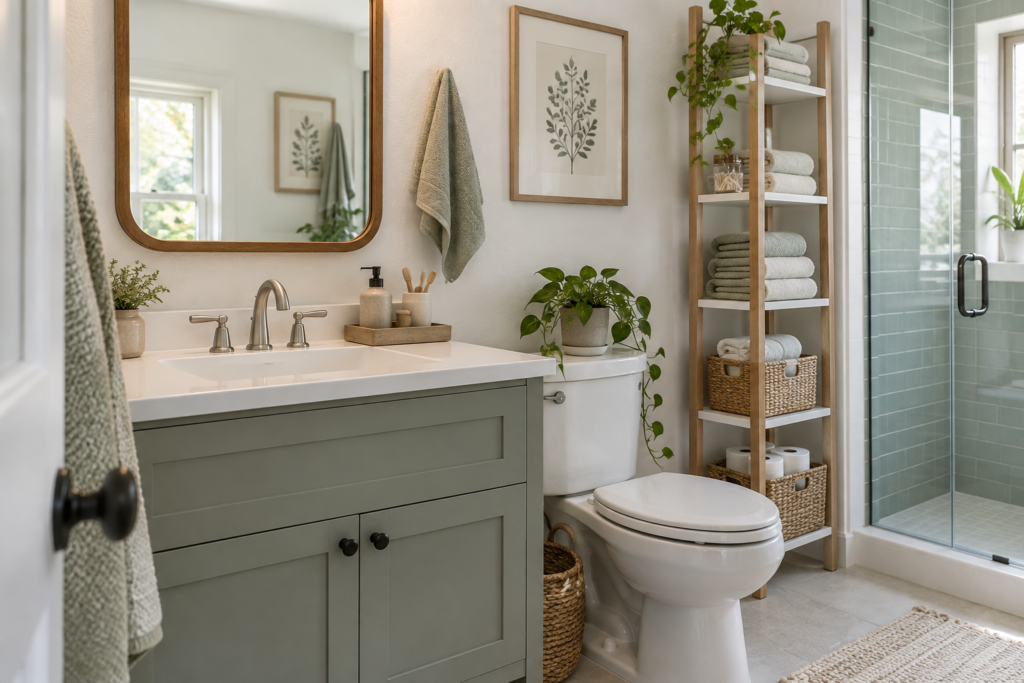
For small bathroom storage, keep the items used every day in one easy-to-reach zone, give each person a clear boundary, and store suitable refills separately. Use a small tray, shallow drawer insert, or removable personal caddy according to the available space. Keep wet items, clean dry supplies, cleaning chemicals, and electrical appliances in locations appropriate to their different needs.
A crowded bathroom counter is often a sign that the storage routine asks too much of the person using it. If putting away a toothbrush or lotion requires moving several bottles, the item will probably stay beside the basin. The answer is not always a bigger cabinet. It may be a smaller daily collection, a shallower tray, or a personal caddy that can be returned in one movement.
This guide explains how to build that everyday system, compare organizer formats, and test the result during normal morning and evening routines. It focuses on storage and access, rather than medical or product-use advice. Follow the directions on toiletries, medicines, cleaning products, and appliances for their specific storage requirements. Our editorial policy explains how we approach practical guides.
Sort by routine before deciding where items belong
Gather the products currently on the counter and inside the most crowded drawer. Separate daily items from occasional items and unopened reserves. Keep an additional group for products whose storage directions or condition you need to check. Do not automatically return everything to the bathroom merely because it was there before.
Use an actual morning and evening routine to identify the daily group. Include the tools needed to apply or use a product, such as a brush or other personal accessory. The practical unit is the task, not just the bottle. A daily item is still inconvenient if its matching tool is hidden elsewhere.
Define a working quantity
Keep the quantity you are actively using near the point of use, where its instructions permit. Store suitable unopened replacements separately so the daily area does not become a shop display. A family may need several personal products in use at once; the goal is clear ownership and access, not forcing everyone to use an arbitrary number of bottles.
Review duplicates before purchasing another organizer. Multiple nearly identical products may be a choice, but they still require space and a way to identify which is open. A small reserve basket can make stock visible without crowding the counter. Check that basket before shopping rather than depending on memory.
Keep personal and shared items distinguishable
Use a simple boundary for personal items when several people share the room. This might be one tray per person, separate drawer sections, or labelled caddies. Shared supplies can have their own zone. Avoid using labels so vague that nobody knows whether an item belongs in a personal area or the household reserve.
Consider who needs independent access and who should not have access to particular products. Cleaning chemicals and other potentially hazardous items need appropriate secure storage. A child-height shelf should not be designed solely around convenience. Product directions and household safety needs take priority over an aesthetically symmetrical arrangement.
Measure the spaces and the movements
Measure counter depth, drawer interiors, shelf height, and cabinet openings separately. Include faucet handles, basin curves, pipework, hinges, and electrical fittings. A rectangular tray may have an appealing footprint but leave too little room around a curved basin. A drawer insert may fit the width but prevent closure once tall bottles are placed inside.
Counter measurements
Start with the area that remains usable when the basin is in normal use. Keep the faucet controls accessible and check whether a tray can be lifted out for cleaning without tilting its contents. Do not fill the entire counter simply because a wide organizer fits. You may need an open area to set down an item temporarily during your routine.
For example, a clear patch measuring 28 by 18 cm does not automatically suit a tray advertised as 28 by 18 cm. The widest rim or handles may project beyond the base, and a tight fit may make lifting difficult. These are example measurements; compare the outside dimensions of a real tray with your own space and its removal path.
Drawer and cabinet measurements
For drawers, measure the height available beneath the structure above when closed. Include pump heads and lid tabs. If products must lie down, check whether their packaging and instructions make that appropriate; do not assume every bottle remains leak-free horizontally. A different storage location may be better than forcing a tall item into a shallow drawer.
For cabinets below a basin, map the plumbing as fixed obstructions and keep service access clear. Our under-sink storage guide explains how to measure separate usable areas around pipes. A compact personal-care bin may fit beside the basin projection, while a tall two-tier unit may not.
Build three everyday zones
Zone 1: daily essentials
Keep the daily group where you can reach and return it with minimal rearranging. A tray works when a few items can remain appropriately on the counter. A shallow drawer works when it opens easily and holds the products in a suitable orientation. A portable caddy works when each person brings a group out, uses it, and returns it to a designated place.
Test whether each item can be removed individually. A row of bottles that requires lifting the tallest one first is likely to become a cluster on the counter. Put frequently used small items where they remain visible, and avoid placing them behind a decorative container that serves no storage purpose.
Zone 2: reserves and occasional supplies
Keep suitable unopened replacements in a separate labelled area. Group them by a useful category, such as hair-care reserves or shared wash supplies. The storage directions on the product still apply, so a bathroom cabinet is not automatically the right home for every refill. Some items may be better stored in a suitable location elsewhere.
Occasional tools should not occupy the most convenient daily space unless that is the only suitable location. Give them a clear home that remains easy to retrieve when needed. If reaching an occasional item means unloading personal toiletries, consider a separate removable bin or a different shelf allocation.
Zone 3: used or wet items
Decide where used washcloths, damp accessories, and other wet items go after use. They should not simply be pushed into the same enclosed bin as clean, dry supplies. Use a drying or laundry arrangement appropriate to the items and the room. An organizer with holes is not a complete moisture-management plan if water collects on the surface beneath it.
Choose storage that can be removed and cleaned according to its care instructions. Check the surrounding surface too. A container can look clean from above while moisture remains underneath. If the room has recurring dampness, address the cause rather than trying to conceal it with deeper baskets or extra liners.
Compare organizer formats by their job
| Format | Useful when | Main limitation | Check before buying |
|---|---|---|---|
| Counter tray | A small daily group belongs near the basin | Uses counter space and needs cleaning underneath | Outside footprint, rim, removal clearance |
| Drawer insert | Small personal items shift or mix together | Fixed compartments may not fit actual products | Internal drawer height and compartment sizes |
| Personal caddy | Several people share limited counter space | Requires a suitable parking and return location | Loaded weight, handles, care instructions |
| Shelf basket | Reserves need a defined group | Deep baskets can hide forgotten stock | Visibility, shelf load, retrieval height |
| Door-mounted holder | Light accessories need a clear home | May collide with shelves or hinges | Door thickness, mounting method, closed clearance |
Tray: the simplest counter boundary
A tray can keep a few daily items together and make the counter easier to clear for cleaning. Its value comes from a clear boundary, not from increasing capacity. If the tray is constantly overflowing, reduce or redistribute the category before choosing a larger version. Compare a low rim that permits easy retrieval with a high rim that contains small items but may conceal them.
Check the material’s stated care requirements. Do not assume that a decorative wooden, stone, or metal tray tolerates repeated moisture exposure simply because it is sold alongside bathroom accessories. The finish, base, and manufacturer’s instructions matter. A practical tray should be easy to lift with the intended contents and clean as required.
Drawer insert: precise separation
Fixed inserts work when compartments match the items you use. Adjustable or separate small trays offer more flexibility when product sizes change. Measure your longest brush and widest container, then compare the usable compartment dimensions rather than the insert’s overall footprint. A large outer tray can contain several compartments that are individually too narrow.
Leave enough space to retrieve small items without repeatedly lifting neighbouring products. If a drawer is shared, personal boundaries may help more than sorting every item by type. Choose the arrangement that reduces confusion during the busiest routine, and verify the drawer closes smoothly when fully stocked.
Personal caddy: one group in, one group out
A caddy suits a shared bathroom when people need different products and the counter cannot hold them all. Give each caddy a defined storage location and ensure its contents suit that location. Test carrying the loaded caddy and setting it down securely. Tall bottles can change its balance, while an oversized handle can prevent it fitting beneath a shelf.
Do not make portability an excuse to mix every type of supply. Cleaning chemicals, electrical appliances, wet accessories, and personal toiletries may have different storage requirements. Use the caddy for a coherent group that can be handled and returned appropriately, rather than one mixed collection for the entire room.
Adapt the plan to your bathroom
Pedestal basin with no vanity
Keep a modest daily group in a suitable nearby location rather than balancing everything around the basin rim. A personal caddy stored elsewhere may work well. If considering a narrow cabinet or shelf, measure the room’s movement paths, door swing, and installation requirements. Do not obstruct access to plumbing or assume that a tight gap is automatically a suitable storage location.
Small vanity with one shared drawer
Divide the drawer into a few clear personal or task-based sections. Store tall products elsewhere if they cannot remain in an appropriate orientation while the drawer closes. Use the under-basin cabinet only where items fit around plumbing and their storage needs are met. Keep the most frequently handled items in the easiest section rather than splitting the space equally by appearance.
Bathroom with an open shelf
Use the shelf for manageable groups whose contents suit the environment. A labelled reserve basket may be useful, but avoid a heavy high-level bin that is awkward to lift down. Keep clean supplies protected appropriately and check the shelf’s rated capacity and mounting instructions. Open display should not override the practical needs of the items stored.
Give electrical appliances a separate storage decision
Hair dryers and other electrical tools need their own appropriate location and handling routine. The US Consumer Product Safety Commission’s home electrical safety checklist advises unplugging small appliances when not in use and notes the shock risk if plugged-in appliances fall into water. Follow your appliance’s instructions and local electrical-safety requirements; a tidy cable does not remove that risk.
Store a tool only after following its cooling and storage directions. Do not put a hot appliance into an ordinary cosmetic bin or assume that a holder marketed for hair tools suits every appliance. Check the specific compatibility and temperature guidance. Keep cords from being trapped by drawers or doors, and do not stretch an appliance lead across a wet area to accommodate a chosen organizer.
Test the system during morning and evening use
Use the arrangement for several ordinary routines. Notice which items stay out because returning them is awkward, which products are repeatedly moved aside, and whether the basin and counter remain easy to clean. Ask another household member to put their items away without being coached. Their choices show whether the boundaries are understandable.
Change one failure at a time. Move a frequently used item forward, reduce the depth of a group, or separate reserves from active supplies. If the daily tray is full, first check whether it contains items that are not actually used daily. Adding height or another tier may make the area harder to reach and clean.
A brief reset that matches the room
Return the daily groups, move used items to the appropriate laundry or drying place, and check that the counter can be cleaned without dismantling the arrangement. Review reserve quantities before shopping. This routine should remain simple enough for the household to follow; an elaborate labelling system will not compensate for inaccessible storage.
When the layout repeatedly fails in several parts of the home, use the whole-home storage reset to prioritize the causes. The bathroom may be carrying overflow that belongs elsewhere. Resolving that boundary can be more useful than buying a larger bathroom organizer.
Questions about small bathroom storage
What should stay on a small bathroom counter?
Keep only the appropriate items you use frequently and can store there according to their directions. A small tray can define the group. Leave enough practical space for basin use and cleaning, and give reserves or occasional products a separate suitable location.
Are drawer organizers better than countertop organizers?
They solve different problems. A drawer insert can keep small items separated and off the counter, while a tray can make a compact daily group easy to reach. Choose based on drawer clearance, product orientation, and the number of steps required to return an item.
How should two people share one small bathroom?
Use clear personal boundaries for individual toiletries and a separate area for shared supplies. Personal caddies or drawer sections can work. Test the busiest routine and the return step, then adjust the space according to actual needs rather than insisting on identical containers.
Can I keep all spare toiletries in the bathroom?
Check each product’s storage instructions and the conditions in the proposed location. Keep only suitable reserves there, grouped so you can check them before shopping. A different appropriate location may be preferable for some products or when bathroom capacity is limited.
What makes a bathroom organizer worth buying?
It should solve a specific access or separation problem, fit the measured space, suit the intended environment, and be practical to clean. Compare its limitations as well as benefits. Our buying guides provide a broader checklist for evaluating storage products.