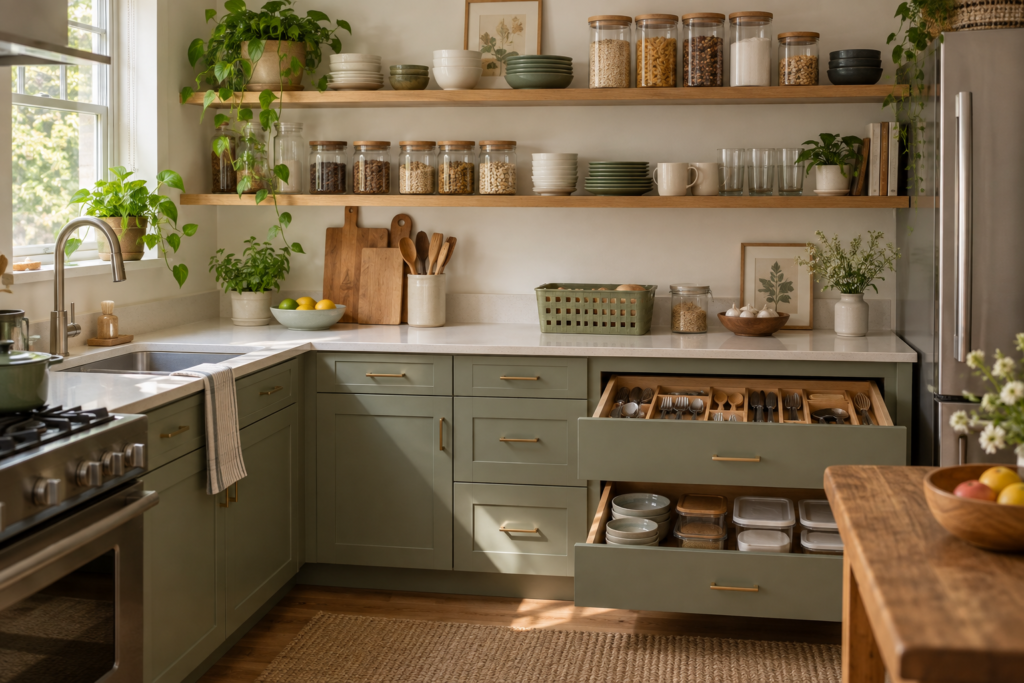
For food container lid storage problems, when container lids become difficult to find or store, check compatibility before changing the organizer. Separate confirmed matches, temporarily hold uncertain pieces, and identify whether the remaining problem is support, drawer clearance or too many sets in one zone. Keep the daily collection small enough to return after washing without forcing lids into gaps.
The most annoying lid problems repeat at predictable moments: you are packing leftovers, a child needs a lunch box, or the dishwasher is full of clean containers. A drawer can look orderly between those moments and still fail every time it matters. Troubleshooting should therefore begin with the task that goes wrong, not with the appearance of the stored collection.
This guide addresses matching and storage faults rather than food preservation claims. Follow each container’s own instructions for use and care. If you are starting with an unsorted collection, use the food-container lid setup guide first, then return here for persistent problems.
Identify which part of the routine is failing
There are three separate decisions in a typical container routine: choosing a suitable base, finding its intended lid, and putting the clean pieces away again. A layout can support one decision while obstructing another. For example, a tight rack displays lids clearly but may make unloading slow because every piece needs careful alignment.
Observe one normal attempt without reorganizing halfway through. Write down what you move before reaching the correct lid and what prevents it from returning easily. If the answer is “I cannot distinguish two similar lids,” new dividers may not help. If the answer is “the correct lid is obvious but trapped behind larger ones,” the arrangement needs better access.
Keep the diagnosis concrete. “Too many lids” might really mean too many incompatible families, or it might mean one large round lid is covering every smaller piece. Different causes justify different changes. Try the smallest adjustment that addresses the observed fault, then check it during the next real use.
| Symptom | Likely question | First experiment |
|---|---|---|
| A lid almost fits several boxes | Are these separate product families? | Verify matches and separate families |
| Upright lids collapse | Is the support too wide or too shallow? | Narrow the section without squeezing lids |
| The drawer catches | Is a lid taller than the opening? | Check the tallest lid through the full closing path |
| Everything fits until washing day | Was capacity measured with pieces missing? | Test the complete clean collection |
| One large lid blocks the rest | Does it belong in the daily zone? | Store the occasional set separately |
Similar-looking lids keep getting mixed together
Transparent lids from different ranges can appear interchangeable even when their rims differ. Start by identifying confirmed pairs through markings and the intended fit. Do not use force as a compatibility test. A lid that can be pressed onto a base is not necessarily the lid the manufacturer designed for it.
Once you know the families, give each an identifiable location. Two adjacent sections can be enough; you do not need a separate rack for every brand. If one family has a distinctive clip colour, use that feature in the section label. If visual differences are subtle, a product-family name or simple household code on the organizer can help.
Consider whether maintaining several nearly identical systems is worth the daily confusion. You do not need to discard sound containers immediately, but future replacement purchases can favour an already useful compatible range where appropriate. Make that decision from confirmed compatibility information rather than assuming all products from one brand share lids.
Lids fall over as soon as one is removed
This usually means the remaining lids relied on the removed piece for support. A loose vertical collection behaves differently when it is full, half full and nearly empty. Test all three states. An organizer that looks stable only when packed tightly may not work well during a normal week of containers moving in and out.
Move an adjustable divider closer if the organizer permits it, leaving enough space to grip each lid comfortably. The aim is gentle support, not compression. Thick clips and flexible edges should not be forced into a narrow slot merely to achieve a neat row. If the lids vary greatly in thickness, broad family sections may work better than equally spaced individual slots.
For a small group of curved or domed lids, horizontal storage in a shallow section can be more reliable than insisting on vertical display. Put the most frequently used piece where it does not require lifting a heavy stack. The storage direction should follow the shape and use of the lids, not a photograph of a different collection.
The drawer will not close smoothly
Open the drawer and inspect the tallest or most tilted lid first. A lid may stand below the drawer sides but still hit the cabinet opening or a fitting above. Measure the narrowest part of the path and close the drawer slowly while watching the contents. Do not repeatedly push through the resistance.
If the lid leans during movement, the issue may be support rather than height alone. A narrower section or a more suitable organizer can keep it within the tested profile. However, if it is simply too tall, choose a flat arrangement or move that category to a cupboard. Bending a lid to fit can undermine the function you are trying to preserve.
Check dividers and bins as well as lids. A removable bin with high handles can catch even when the lid collection is low. Leave the drawer slides and closure mechanism unobstructed. A storage accessory should operate within the drawer’s existing space rather than requiring the furniture to tolerate repeated contact.
Clean pieces have nowhere to go
An arrangement may look successful because several containers are in the fridge, at work or waiting to be washed. When every piece returns, the apparent spare capacity disappears. Test the full collection before concluding that someone is putting things away incorrectly. The layout may simply have been designed around an incomplete inventory.
Keep a record of the active sets during a typical week and compare it with the available zone. Include spare lunch boxes and occasional leftovers containers if they genuinely belong there. If the complete collection does not fit without squeezing, move occasional sets or reduce unnecessary duplication instead of creating a temporary pile on the worktop after every wash.
Another option is to change the storage method for just one category. Complex lunch kits can remain as complete sets, while straightforward bases nest and their shared lids stand separately. Mixing methods can solve a capacity problem more effectively than applying a single rigid rule across every shape.
The drawer contains many lids but few useful sets
Create a short reconciliation session. Pair the clean pieces, identify those still in use, and hold uncertain items outside the daily drawer. Give the temporary group a review date that allows normal household circulation to finish. Without that boundary, an “unmatched” box easily becomes a second permanent collection of unused parts.
Inspect intended pairs for condition according to the product’s care guidance. A cracked lid or broken fitting is not made useful by finding its base. If a replacement is appropriate, check the exact range and size rather than buying a visually similar part. Record that information before shopping so the replacement decision is specific.
Avoid treating every orphan as something you must preserve indefinitely. The useful unit is the functioning set, unless a piece has another appropriate and clearly defined role. A drawer full of potential future matches is less valuable than a smaller collection that reliably handles the food-storage tasks you actually perform.
The organizer takes more space than the lids
Some lid racks have wide outer frames, tall handles or fixed slots that do not suit a small collection. Compare their external footprint with the usable space inside. If several slots remain empty while thick lids occupy two slots each, the rack may be dividing space in a way your collection cannot use.
Try removing the rack temporarily and arranging the same lids in a shallow bin or divided drawer section already available. This is a layout test, not a reason to buy a second organizer immediately. If the simpler arrangement works, the original rack may be the source of the crowding rather than the solution to it.
Measure the successful trial before considering replacements. Useful criteria might include a lower profile, adjustable divisions or a removable section for round lids. “More compartments” is not automatically an improvement. The right number of compartments follows the compatibility groups and shapes you need to support.
A worked repair for a drawer that keeps reverting to a pile
Consider a drawer with fifteen lids from four incompatible ranges. The owner has labelled sections by small, medium and large, but two medium families look almost identical. During washing, people place them wherever space is available. Every few days the drawer returns to a mixed stack.
The first repair is to change the primary categories from size to compatibility family. The two confusing medium families receive separate sections with clear labels. The occasional large round set moves to a secondary cupboard. The daily drawer now holds fewer shapes, and “where does this belong?” has a visible answer.
The household then tests the nearly empty drawer while several containers are in use. One group falls flat, so its divider is moved inward. That second adjustment matters: the first solved identification, while the second solved support. Neither required replacing the entire container collection or buying a larger drawer organizer.
When the habit is the problem, simplify the action
A lid system that requires people to memorize a complex arrangement is difficult to maintain in a shared kitchen. Watch how a person naturally unloads clean pieces. If they must open two cupboards, rotate every lid and place each into a precise slot, the storage routine may have more steps than the household will consistently follow.
Bring the destination closer to the bases and make the sections broader where possible. Remove decorative or redundant categories. A short label and a forgiving bin can be more effective than a highly structured rack. This does not mean abandoning order; it means making the correct action easier than dropping the lid somewhere else.
If containers leave the house regularly, assign a clear return location for complete sets. Missing lids may be a circulation problem rather than a drawer problem. Keeping lunch components together during transport can reduce the number of loose pieces that arrive at the kitchen at different times, subject to the products’ normal care and use requirements.
Before buying another organizer
Write down the unresolved symptom and the measurement needed to fix it. For falling lids, compare support and divider adjustment. For a catching drawer, compare overall loaded height. For an inaccessible cupboard, compare bin grip and removal clearance. The product should address that specific fault rather than merely look tidier in a listing.
For wider storage decisions, see the kitchen drawer-divider setup guide and the kitchen and pantry hub. Related zones can sometimes release enough space to solve the problem without adding equipment to the lid drawer itself.
Sources and practical checks
Match by documented compatibility before sorting by size. The Snapware Total Solution lid listing lists the container models it fits. Similar-looking lids should not be assumed interchangeable, and forcing a lid is not a substitute for that match.
Questions about food container lid storage
Why do I always have one more lid than container?
Check containers still in the fridge, lunch bags and washing cycle before deciding a piece is orphaned. If the imbalance persists, identify the original family and verify whether a base has been removed or damaged. A temporary review group prevents the uncertainty from spreading through the active drawer.
Should I label every lid?
Usually a label on the section is simpler and easier to update. If individual identification is necessary, follow the product’s care guidance and avoid adding unsuitable materials to food-contact areas. Labels should clarify a real compatibility issue rather than create maintenance for every piece.
Is vertical storage always the answer?
No. It works well when lids have suitable support and the storage location has enough height. Domed, flexible or unusually thick lids may be easier to keep flat or with their bases. Test removal and return rather than judging only the stored appearance.
Can I replace all lids with one universal style?
Do not assume universal compatibility. Check the intended use and specific compatibility information for any replacement product. This organization guide cannot establish sealing, food-use or heating suitability from size alone. Matching the correct original family is often easier to verify.
How long should I test a fix?
Use it through enough normal packing and washing activity to see the drawer full, partly empty and refilled. Those states reveal different problems. Keep the change if correct matching and return become straightforward; revise it if the same obstruction or confusion remains.
For the wider room layout, explore our small kitchen ideas and keep cabinet access, preparation surfaces and this storage area working together.