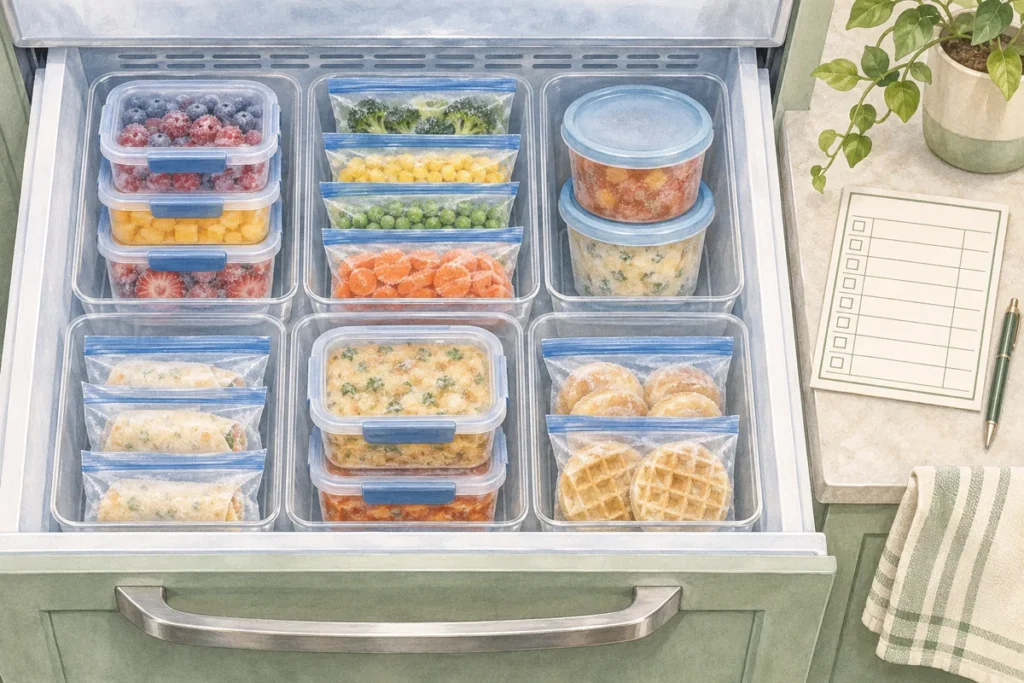
Record the item, portion count, date and freezer location. Update the list whenever food enters or leaves, and label the package itself.
Name locations first
The useful freezer list is one you can maintain while holding groceries. Paper, a phone note or a spreadsheet can all work. Pick the format everyone who adds food can access easily, rather than the most elaborate format.
Name drawers or baskets top, middle and bottom, or A, B and C. Use the same names on the inventory and storage labels. Avoid categories requiring more separate spaces than the freezer actually has. Keep vents and service areas clear according to the appliance manual.
Use four simple fields
Record what the food is, how many portions or packages remain, its preparation or relevant package date, and its location. For example, an entry might read prepared soup, two containers, preparation date, drawer A. This is a record format, not a suggested storage duration.
Put readable information on the package as well. An inventory cannot identify an unmarked mystery bag if the list is lost. When repacking purchased food, retain information you need from the original package.
Distinguish quality from safety
The FoodSafety.gov cold-storage chart gives food-specific guidance and explains that freezer time ranges concern quality when food stays continuously frozen at 0°F/−18°C or below. This condition does not excuse unsafe handling or temperature changes.
Do not use an organization list to decide whether food affected by a power failure is safe. Seek the specific public-health guidance for that event. Follow local recommendations and the food's instructions.
Choose a shape you can retrieve
Measure packages including sealed edges against the drawer opening. Some arrangements suit flat packages filed upright; others suit stacked tubs. Check freezer suitability for the exact container and leave a usable retrieval path.
Try one basket before buying a set. A full basket may be much harder to lift than an empty one. Record portions as they are removed instead of relying on memory at the end of the week. Before shopping, check uncertain entries and revise the list. If you use a temporary area for newly added food, clear it promptly so it does not become another unidentified pile.
Create one entry for one identifiable stored group
Choose the unit before entering a quantity. “Two containers” and “two servings” are different descriptions. If you use container count, state what each container holds sufficiently clearly for the household to identify it. If portions are important, record the actual portion information separately instead of allowing the number to switch meaning halfway through the list. The purpose is to make an inventory update understandable while groceries are being put away or an item is removed.
Keep products and prepared foods identifiable through their appropriate original or replacement labelling. The inventory is a finding aid, not a substitute for relevant packaging information, ingredients, allergen details or food-use instructions. Avoid combining several unidentified remnants into one entry just to shorten the list. If you cannot establish an item’s identity or history, resolve that separately using appropriate food-safety guidance rather than treating an estimated name and date as a reliable record.
Use a sample row to agree on field meanings
For an illustrative inventory, a row could read “vegetable soup; two labelled containers; preparation date as labelled; upper drawer, left basket.” This is a fictional record example, not a recipe or storage-duration recommendation. The quantity counts containers, while the location identifies a group that can be found in the actual appliance. Another household may prefer a different location name. Choose words that its regular users recognize without consulting a complicated map.
Add only fields that support a decision. A household might include a shopping-list check or an indication that one container has been removed. Do not create a guessed expiry date from an assumed universal freezing period. For storage guidance, consult the relevant food category and circumstances using an authoritative source such as FoodSafety.gov’s Cold Food Storage Chart. Its freezer time guidance distinguishes quality from continuously maintained freezing conditions; an inventory date alone cannot establish whether food has remained safe.
Update the record at the point of removal
Suppose the fictional soup row lists two identified containers and one is removed. Change the quantity to one at that point, using the agreed counting unit. If the remaining container moves to another appropriate position, update its location in the same short action. A perfectly organized list becomes unreliable when movements are remembered vaguely and entered much later. Choose a format that can actually be accessed during the household’s normal routine.
When the last item in a group is removed, clear or close that inventory entry rather than leaving a zero-quantity row that looks available at a glance. Keep a separate shopping note only if the item is genuinely wanted again. Not every empty group needs automatic replacement. This prevents the freezer list becoming a permanent list of everything the household has ever bought, which obscures the current contents and encourages unnecessary purchases.
Keep a shopping list separate from a storage record
The inventory describes what is currently identified in the freezer; the shopping list describes a future purchase decision. Connect them through a quick review before shopping, but preserve their different roles. An entry reading “buy chicken” does not tell someone whether an existing package is available. Likewise, an old freezer entry should not be treated as current stock simply because nobody remembers crossing it out.
Before adding a purchase to the shopping list, check the relevant identified group and usable space. A large pack can be poor value for the household if it repeatedly causes unrecorded overflow or awkward stacking. That is an organization and shopping decision, not a food-safety assessment. Preserve the food and appliance requirements when deciding how a new group will be stored, and avoid promising that an organizer will increase the appliance’s permitted capacity.
Name locations that match the real appliance
Use the appliance’s actual arrangement as the starting point: recognized drawers, an appropriate basket or another identifiable permitted position. Do not build a highly divided map that requires many tiny bins before knowing what the household stores. A small set of broad, useful groups may be easier to maintain. Include the way the appliance’s drawers or baskets open, and follow its instructions for loading, circulation and access.
Write location cues on the list in the same words used for the physical arrangement. If one person calls a basket “vegetables” and another calls it “drawer two,” agree on a consistent reference. Keep any external labels appropriate for the actual surface and operating conditions. Avoid covering appliance information or using a label whose material is unsuitable for the location. A location name should reduce searching without creating another maintenance problem.
Compare storage shapes through retrieval
For an illustrative comparison, a flat package may use a shallow group differently from a tall rigid container. Identify the foods and packaging actually involved, then check which suitable shape can be removed individually from the available position. Do not choose a format only because an empty basket fits inside the drawer. Its filled height, handles and the ordinary retrieval route determine whether it is useful after loading.
Try the category boundary without buying several matching bins. If the intended group can already be found and returned, a clearer label may be enough. Where a suitable basket improves retrieval, keep its contents identifiable and manageable according to the actual products and appliance requirements. Separating one awkward oversized group can be more useful than making every item conform to a uniform container system. The result should help locate current stock, not hide several unrecorded layers beneath an attractive top row.
Choose a paper or digital method the household uses
A simple paper list can be convenient when it has an appropriate accessible home outside the appliance. A shared digital note can work when the relevant users have access and know which version is current. Choose through the update routine, not the number of available features. A spreadsheet with many optional fields is less useful than a short note if nobody opens it when taking an item out.
Give one current record a clear title and location. Avoid maintaining a paper list and several unsynchronized phone notes as though they were identical sources. If a temporary note is necessary, transfer its actual change to the main record and retire the duplicate. Keep only the household information needed for finding and updating stock. There is no organizational benefit in attaching unnecessary personal details or a long history of unrelated shopping decisions to each entry.
Review discrepancies without inventing missing history
If the list says three packages but the identified group contains two, correct the current quantity after checking the actual arrangement. Do not invent a date or claim that the missing package was used in a particular meal. Mark unresolved identity or food-history questions for appropriate guidance. An honest simple record is better than a detailed-looking one completed with guesses. The list should describe what can actually be established about the current contents.
Use the discrepancy to improve one part of the routine. Perhaps the digital note is difficult to find, the location name is unclear, or several package types are counted under one ambiguous unit. Change that specific feature and rehearse the next ordinary addition and removal. Review the record after a substantial restock or rearrangement. A useful freezer inventory remains short enough to update and accurate enough to prevent unnecessary searching or duplicate buying, while keeping food-safety decisions tied to reliable guidance and actual conditions.
Common questions
Is a paper inventory good enough?
Yes, if it stays legible, accessible and current.
Should I use identical baskets?
Only if they fit the packages and can be lifted comfortably when filled.
Sources and further reading
- FoodSafety.gov: Cold Food Storage Chart
Explore our Kitchen & Pantry guides, the buying checklist and all home organization guides.
For the related decision, see our meal prep container checklist.