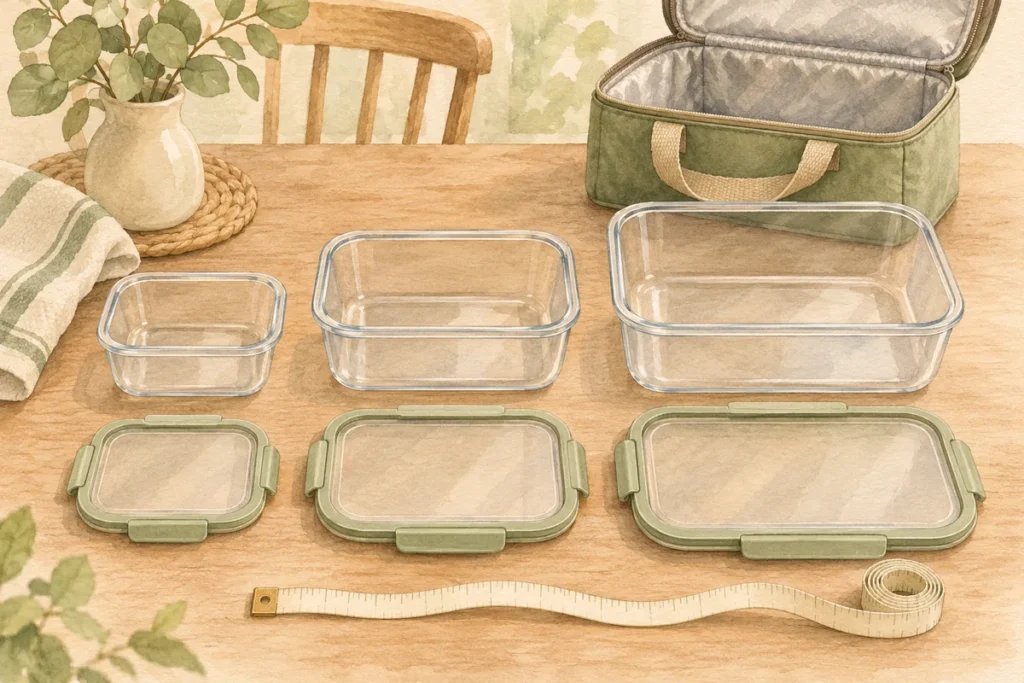
Choose meal prep containers around the meals you actually pack, available shelf space and transport needs. Read the exact instructions for both base and lid.
Start with one ordinary meal
Pack a normal meal in a container you already own. Notice whether a single compartment is enough, whether sauce needs a separate pot, and whether everything fits your lunch bag upright. This trial gives you a concrete buying brief. A large matching set can create more cupboard work than it solves.
List the meals you regularly store, then count the portions that need containers simultaneously. A five-day workweek does not automatically require five identical boxes. Your preparation routine and food-specific safe storage limits still matter.
Measure the filled footprint
Measure outside width, depth and height including clips and lid overhang. Check usable internal capacity separately. A litre measurement describes volume but cannot tell you whether a sandwich fits without being crushed. Compare the container with the actual bag opening and refrigerator shelf.
A divided tray can keep solid ingredients apart, but it is not automatically sealed between compartments. Read the precise claim. If carrying dressing or soup, check the exact closure requirements rather than assuming that the word airtight guarantees transport performance.
Read heating and cleaning instructions separately
Microwave, freezer, dishwasher and oven suitability are different properties. One does not establish another, and a lid may have different restrictions from its base. Keep the instructions with your purchase record. Do not infer oven suitability merely because a container is glass.
Check whether seals are removable, how they must be cleaned and whether replacement lids are available. Buy only the formats you can maintain comfortably. An elaborate closure that is difficult to dry may not suit everyday use.
Keep food safety separate from storage design
USDA guidance on leftovers recommends prompt refrigeration and dividing large quantities into shallow containers for cooling. Attractive packaging does not extend a meal's safe storage time. Check food-specific advice and local public-health guidance.
Trial one or two containers before buying a complete set. Fill them, carry them as directed, wash and dry them, then put them away. Keep complete serviceable sets in the active cupboard. If lids become an expanding pile, reduce the number of formats instead of purchasing another organizer.
Make a packing brief before comparing sets
Write down three meals you actually pack, then describe their shapes and components. A sandwich needs a useful flat area; a portion with separate toppings may need several pieces; a liquid meal needs a closure expressly suited to that use. These are different equipment jobs. Avoid selecting every container from the same advertised capacity. Check the usable interior and the complete outside shape for the particular meal, and keep any unconfirmed product claim on the question list rather than assuming it is true.
Count how many complete sets are occupied at the same time. Include packed meals, containers awaiting the required cleaning, and any sets genuinely needed before those pieces return. This is an equipment inventory, not a recommended duration for storing prepared food. A household that washes a lunch container every evening may need a different collection from one with several people leaving home together. Record the actual simultaneous demand before comparing a large promotional bundle with a smaller selection of useful shapes.
Use this measurement sheet for each exact container
Measure the closed container with its own lid attached. Write the external width, depth and height, including projecting clips or handles, in one consistent unit. Separately note the opening shape and the product’s stated capacity. If the inside is tapered, the top opening and base can accommodate different shapes. Do not treat a capacity figure as a promise that a particular sandwich, meal component or separate sauce pot will fit. List these unknowns before deciding whether the format is worth a trial.
Measure the destination as carefully as the container. Check the lunch bag’s usable opening and the route past its zip, then the available internal space. Check the actual refrigerator shelf with its normal contents in place. A box can enter an empty bag diagonally yet be awkward to insert when another meal component is already packed. Compare the whole carrying arrangement rather than adding catalogue volumes together. Preserve the transport conditions required for the food; fitting a bag alone does not establish that it is safe to carry.
| Check | What to record | Decision |
|---|---|---|
| Closed footprint | Width, depth and height, including clips | Compare with the bag opening and shelf |
| Meal shape | Usable interior and any separate components | Confirm the actual meal fits |
| Permitted uses | Separate instructions for base, lid and seals | Mark missing information unconfirmed |
| Care and return | Required process and complete-set storage home | Check that the routine is manageable |
Worked fit example: capacity is not the deciding number
Consider a fictional lunch bag with a usable opening of 22 by 15 centimetres and two candidate boxes. Box A is documented as 24 by 16 centimetres including its clips, while Box B is 20 by 13 centimetres. Box A is larger than that opening in both directions when presented flat. This flags a fit concern before purchase; it is not proof that a flexible bag can or cannot accept it in another orientation. The household must check the actual opening, container and packed contents without forcing them.
Box B passes only that first dimensional comparison. Its height, closure, usable interior and intended uses still need checking, along with space for any other items and the full packed arrangement. These invented numbers illustrate a comparison method rather than a tested product recommendation. If the bag has a rigid insert or narrows toward its base, take those measurements too. Keep the manufacturer’s exact dimensions and your own observations separate so a later change of model or bag does not inherit an unsupported fit claim.
Separate lunch-box storage from takeaway packaging
An ordinary takeaway tub is not automatically a reusable meal-prep system. Identify its intended use from the supplied product information. Do not infer repeated-use, reheating, dishwasher or freezing suitability from its shape, colour or resemblance to another container. For soup or dressing, inspect the exact closure and transport instructions. A lid that sits securely on a shelf may have no documented claim for carrying liquids. If the information needed for your intended use is absent, choose equipment with clear applicable instructions instead of guessing.
A soup container also needs an appropriate handling and carrying arrangement. Check the complete closed shape, whether the product is intended to travel upright, and what the maker says about filling, sealing and use. A divider or small insert does not necessarily provide a sealed compartment. Describe only the actual documented feature when comparing products. The meal’s preparation, cooling, storage and transport decisions require relevant food-safety guidance; the container comparison cannot supply a general safe time or temperature merely because a product is marketed for meal preparation.
Compare the full base-and-lid system
Create a separate line for each permitted use: refrigerator, freezer, microwave, dishwasher and oven. Record what the manufacturer says about the base, lid, seal and vent where present. Leave an unknown field marked unconfirmed. A statement about one component or one use does not establish the others. Follow the exact instructions, including restrictions, rather than comparing only a prominent material label. Save the product name and instruction location so you can identify which information belongs to the set after the packaging is gone.
Check the replacement-parts position before building a collection. Are lids sold for the exact model, and can you identify the correct version? Similar-looking pieces do not prove compatibility. Where seals or other removable pieces exist, follow the prescribed cleaning, drying and reassembly process. Compare that work with the time and facilities available in your routine. A complicated set that is difficult for you to maintain may be a poor everyday choice even when its advertised dimensions appear suitable for your meals.
Trial one format through the entire return cycle
Use a permitted ordinary task to evaluate a candidate you already own or decide to purchase. Record how the intended meal fits, how the complete set fits its destination, and how the instructed cleaning and drying process works. Do not invent a leak test or appliance trial outside the product instructions. Note what you actually observed and what remains untested. One successful packing day can identify a useful format for that task; it does not demonstrate long-term durability or every advertised performance claim.
Then return every required piece to its cupboard home. Count the collection when all sets are back, not only when half the containers are elsewhere. Give the recognised lids a clear relationship to their bases and keep damaged or unresolved mismatches out of the ready group. If returning the set is repeatedly awkward, simplify the number of formats before buying a separate organizer. Use the food-container lid guide for the storage layout and keep the exact product instructions available for the next person who uses the set.
For the cupboard layout, follow the food container lid storage guide. For food stored on refrigerator shelves, compare the refrigerator shelf-map method.
Common questions
Is one material always best?
No. Compare weight, breakage risk, allowed uses and cleaning requirements for the exact product.
Must every container be identical?
Only if your portions and uses are similar. A limited selection of compatible formats may work better.
Sources and further reading
- FDA: Refrigerator food safety guidance
- USDA: Leftovers and Food Safety
Explore our Kitchen & Pantry guides, the buying checklist and all home organization guides.