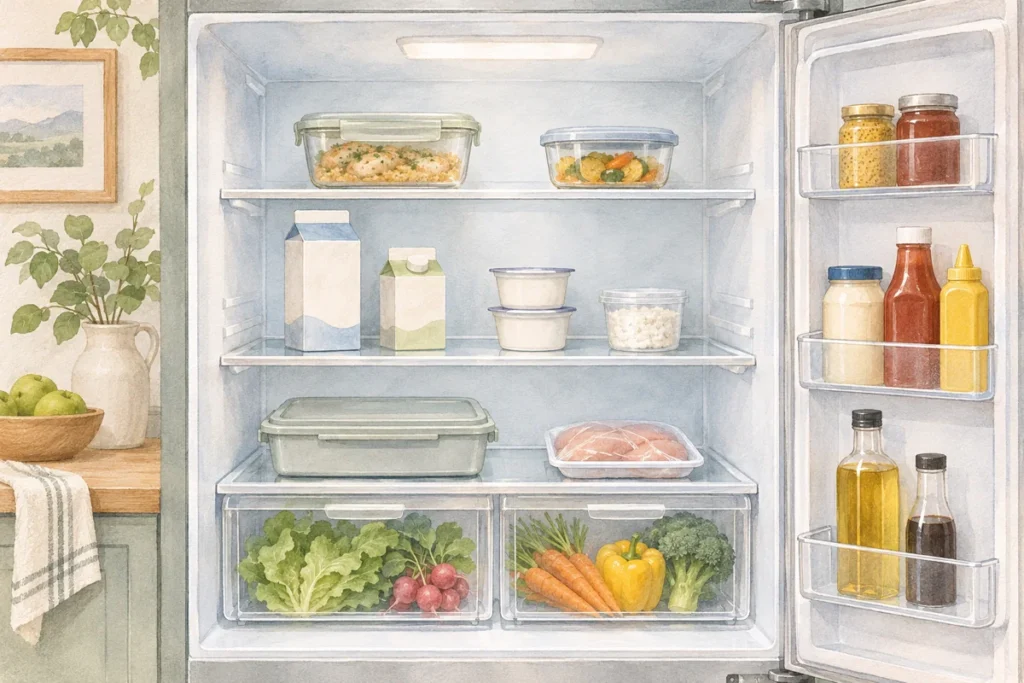
Give foods visible locations while preserving appliance instructions and food-safety requirements. Readable dates and easy access matter more than matching bins.
Record the problems before changing shelves
A refrigerator is active storage: groceries arrive, portions change and leftovers appear. Notice which packages disappear behind others, which items fall over and which drawers become difficult to open. Start with one problem rather than redesigning every shelf.
Measure usable width, depth and clearance below the next shelf. Include supports, light housings and the door closing path. Check the appliance manual before moving shelves or placing bins near vents. A container that fits on an empty shelf can still obstruct a drawer when filled.
Keep visibility separate from safe storage
USDA refrigeration guidance recommends a refrigerator temperature at or below 40°F/4°C and containing raw meat, poultry and seafood so juices cannot contaminate other food. Use an appliance thermometer as directed. An organizer is not a temperature control.
Do not assign every food a universal shelf based only on a diagram. Designs differ. Package directions, contamination prevention and actual temperature come before a visual theme. Follow local public-health advice when it differs or is more specific.
Make dates visible
Put readable preparation or opening dates on relevant containers. A front-facing use-first group can remind you to check food, but should not mix items that require separation. The group never overrides safe storage limits.
Try a shallow removable tray for small packages. Check that its sides do not hide labels. Reserve suitable height for tall cartons instead of balancing them among short tubs. Keep groups small enough that one item can be removed without unloading the shelf.
Choose fewer organizers
Measure the actual food group. A category containing three jars and one large bottle may be better served by a plain tray than rigid compartments. Read organizer cleaning instructions and allow washed pieces to dry as directed.
Review stock before shopping. If a group regularly overflows, change its allocation or purchasing quantity. If a bin stays empty, remove it. A successful arrangement remains understandable during a busy week and makes spills easier to discover, rather than hiding them beneath a decorative liner.
Make a location map rather than a fixed food rule
A refrigerator map should describe where your recognised food groups actually live while respecting the appliance and relevant food guidance. It does not need to prescribe one identical shelf arrangement for every model. Begin with the current appliance instructions and the foods you normally handle. Identify usable locations, fixed features and any required separation or access considerations. A map that fits an attractive online photograph can be unsuitable for a different refrigerator or for foods with different handling needs.
Name the locations using descriptions the household can recognise, such as an identified shelf or a specific appropriate compartment. Avoid ambiguous labels that depend on remembering a colour code from a previous tidy-up. Keep actual food identity and relevant package information available. The map is a navigation tool that helps people locate and return the intended item; it should not create a claim that a broad category label establishes storage suitability for everything placed beneath it.
Separate the inventory decision from food safety
List what is actually present before choosing new bins. The household may have duplicate shopping because existing items are hidden, or a returning item may have no recognised suitable destination. Those are identification and access problems. They should be described clearly while actual storage and safety decisions follow appropriate food guidance. A well-organised shelf does not establish the condition of its contents, and an inventory note cannot reconstruct a temperature or handling history that was never known.
Keep the record useful at selection and shopping. Name the exact item and its recognised location, preserving the information relevant to its actual use. If a question about condition, storage or handling is unresolved, direct it to appropriate guidance rather than placing the item into a decorative group and treating the issue as settled. The organising process should make accurate information easier to find and separate current known contents from uncertain decisions instead of hiding those differences inside matching containers.
Worked example: a purchased item hidden behind a bin
Imagine a household repeatedly purchasing an item because the existing package sits behind an opaque storage bin and its location is not recorded. In this hypothetical example, the household identifies an appropriate recognised destination and updates a short map or inventory cue. It preserves the product information and follows the relevant storage guidance. The improvement concerns visibility and shopping awareness. It does not mean that a package becomes suitable to use merely because it has been found or added to the inventory.
The household checks whether another person can locate the item using the revised arrangement. If they still need to move several unrelated groups, the destination or label needs improvement. The example does not recommend removing product information, combining batches or moving food into a location chosen only for visual convenience. A successful map connects the real package with an appropriate home and a current identity cue, while leaving handling, storage periods and suitability decisions to accurate food-specific information.
Consider the complete bin and its retrieval
If a bin is being considered, compare its occupied shape and usable opening with the actual intended group and refrigerator location. Include the way it is retrieved and returned, not merely its closed footprint. Follow the appliance’s instructions and relevant food guidance when arranging contents. An accessory advertised as a refrigerator organiser does not establish that every placement or contents combination is suitable. Keep any unanswered fit or environmental question visible until appropriate information resolves it.
FDA guidance cautions against overpacking refrigerated food because cold air needs to circulate. Use that guidance alongside your appliance information rather than maximising the number of bins in a shelf photograph. The buying brief should explain the access problem to solve and the relevant group identity. An organiser that hides package labels or encourages an unsuitable crowded arrangement has not necessarily improved the routine. Compare a clearer appropriate location without a new bin before assuming additional equipment is the missing feature.
Give grocery returns an understandable destination
Decide how a newly acquired item finds its appropriate home using the actual product information and relevant guidance. A clear map can help another household member follow that destination without leaving the item in an unspecified overflow area. Keep the process compatible with prompt appropriate handling. Do not turn organising into a prolonged display task while food requires another action. The map should support the real return routine, including knowing which location belongs to the identified item.
Update the inventory when the content or product changes. A permanent organiser label can remain in place even after a different product enters the group, so check that it still points to accurate information. Keep original instructions accessible and avoid inferring equivalence from similar packaging. Remove obsolete shopping reminders when resolved. A current location cue is more useful than a detailed old list that sends the household searching for an item no longer present or repeatedly purchasing one already available elsewhere in an appropriate location.
Review a repeated search rather than resetting every shelf
Choose one recurring search problem and identify where it begins. The item may be hidden, the location name may be unclear or several products may share an ambiguous group. Adjust that specific organisation issue while following the actual appliance and food requirements. A complete refrigerator redesign is not automatically necessary. Preserve accurate product information during the change and avoid treating a new container as evidence that an unresolved handling or storage question has been answered.
Review the map when the appliance arrangement or normal household contents change. A replacement shelf layout can make an old location cue inaccurate. Keep the description simple enough to update rather than depending on a complex numbered system that nobody maintains. The useful result is an appropriate home for known contents and a clear route to relevant information. It makes choosing, returning and shopping more understandable without converting the refrigerator map into a promise about shelf life, safety or universal placement.
What belongs on a refrigerator map?
Use recognised locations and the actual groups assigned to them, with clear links to relevant product information. Keep the map concise enough that another household member can use it during an ordinary return. Do not add invented storage limits or claim that the diagram proves food suitability. Follow current food guidance and appliance instructions for those decisions. Update the map when the layout or contents change and remove obsolete groups. A useful map reduces location uncertainty while preserving the difference between finding a food and deciding whether its particular handling and storage circumstances meet appropriate requirements.
Common questions
Do clear bins keep food safe longer?
No. They can improve visibility; handling, temperature and food-specific limits still apply.
Can every refrigerator use the same map?
No. Adapt it to your appliance, packages and household.
Sources and further reading
- FDA: Refrigerator food safety guidance
- USDA: Refrigeration and Food Safety
Explore our Kitchen & Pantry guides, the buying checklist and all home organization guides.
For the related decision, see our meal prep container checklist.