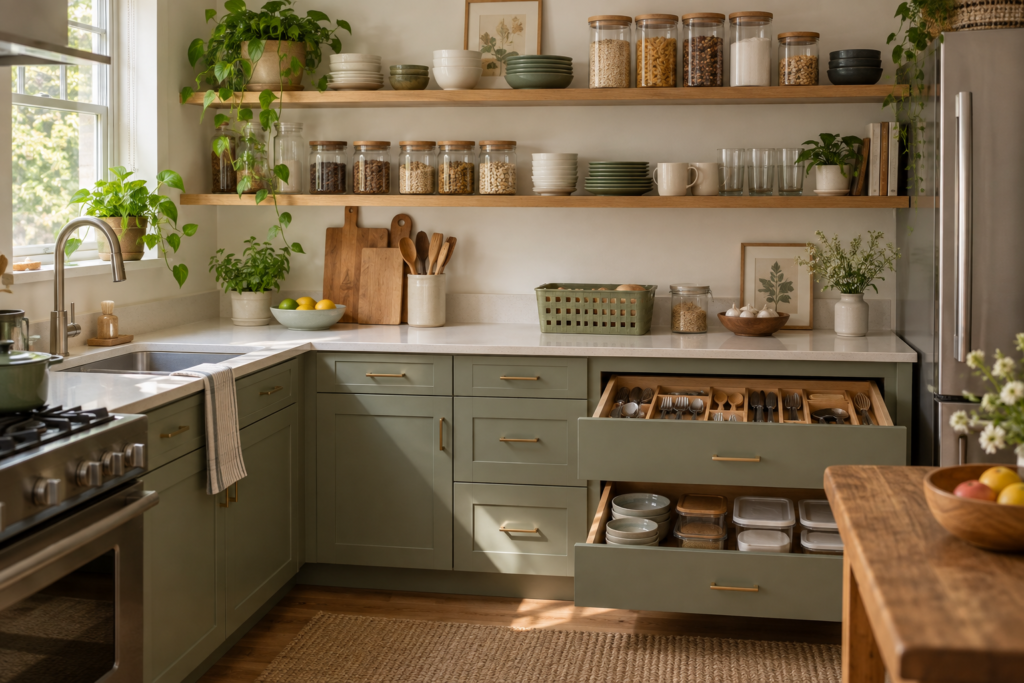
For kitchen drawer divider options, choose a fixed tray when its compartments already match your cutlery, an expandable tray when adjustable outer width is useful, separate dividers when long utensils need custom lanes, or modular bins when categories change. Compare usable compartment dimensions, drawer closing clearance, movement, and cleaning requirements before judging appearance or price.
The best drawer organizer is not necessarily the one with the most compartments. Every wall and adjustment mechanism consumes space. A compact cutlery tray can be ideal for everyday forks and spoons yet unsuitable for ladles, whisks, or measuring tools. Start with the actual contents and the task the drawer supports, then compare formats that can perform that job.
This is a buying framework, not a ranked list of products we have tested. It explains the trade-offs to check on current local listings and manufacturer diagrams. Read our editorial policy for how we describe recommendations. If your current arrangement fails in a specific way, the drawer divider troubleshooting guide can help determine whether buying anything is necessary.
Measure the drawer and its full contents first
Record internal width, depth, and usable height with the drawer closed. Include sloping sides, rounded corners, and any obstruction beneath the counter. The drawer front may be larger than the usable interior. Measure the removal route too, because a tray that sits inside comfortably may not lift out easily for cleaning.
Gather the normal full quantity of utensils, including those waiting to be washed or put away. Identify the longest tool, widest head, and tallest natural resting position. Those dimensions matter more than a generic description such as “large utensil.” Keep knives and other specialist sharp tools in appropriately designed protective storage; an ordinary divided tray is not automatically suitable for exposed blades.
Read external and internal dimensions separately
External dimensions tell you whether the organizer can occupy the drawer. Internal compartment dimensions tell you whether the utensils can use it. Thick walls, curved ends, and expansion tracks can make those numbers substantially different. A listing that provides only overall width leaves an important question unanswered if your tools need unusually wide channels.
Include room for fingers to retrieve items. A utensil can physically fit a compartment yet be inconvenient to remove because its head fills the available space. Look at the movement from above and the side. If your usual hand position cannot grasp it comfortably, consider another compartment arrangement rather than treating a tight fit as efficient storage.
Compare the four main formats
| Format | Strong use case | What you give up | Essential check |
|---|---|---|---|
| Fixed tray | Stable cutlery groups with predictable sizes | Flexibility to change channels | Each compartment’s usable dimensions |
| Expandable tray | Filling different drawer widths | Some space to overlaps and mechanisms | Which sections expand and how they lock |
| Adjustable dividers | Long custom lanes for cooking utensils | Built-in containment for small pieces | Contact-surface compatibility and range |
| Modular bins | Mixed tools and changing categories | A single stable removable unit | Combined footprint and movement in use |
Choose the format before the finish. If you need wide lanes for cooking tools, comparing several attractive fixed cutlery trays may never produce a good fit. If the drawer holds ordinary cutlery in stable quantities, an elaborate custom divider system may add unnecessary decisions. The category’s shapes and the household’s return routine should lead the choice.
Fixed trays: simple when the compartments fit
A fixed tray provides a ready-made layout. It can be easy to remove as a unit and gives familiar categories a consistent home. This works particularly well when the cutlery dimensions and quantities match the channels. Its weakness is the same feature: the boundaries cannot usually be moved when a new tool or a larger quantity needs space.
Who should consider a fixed tray?
Consider it for a drawer whose main purpose is everyday cutlery and whose contents change little. Compare the long channels, any short crosswise section, and the depth of the tray walls. Check that the normal full quantity remains below the closing clearance. Extra channels have value only if they suit a category you actually store.
A one-piece tray can also simplify cleaning if it lifts out easily and the material’s care instructions suit your routine. Inspect whether corners and moulded details are accessible. Do not assume the simplest-looking tray is dishwasher-safe or that a particular material permits soaking; follow the exact product guidance.
When to skip a fixed tray
Skip or reconsider it when the largest utensils cannot fit without diagonal stacking, when several compartments would remain unused, or when the central channels are too narrow. A wide drawer does not require a tray covering its entire footprint. A smaller appropriate tray beside a defined utensil lane may be a better arrangement.
Be cautious about buying solely from a photograph containing unusually small sample utensils. Compare the dimension diagram with your actual tools. If internal measurements are unavailable and fit is critical, choose an option with sufficient information or a practical return policy rather than assuming scale from the image.
Expandable trays: adjustable footprint, not unlimited flexibility
An expandable tray changes its outer width to use more of a drawer. It can be useful when a fixed size leaves an awkward gap or when you expect to move the organizer to another compatible drawer. However, expansion often affects only side sections. The centre channels may remain exactly the same size.
Check both the smallest and largest configurations
Compare the stated range with your drawer, including any practical clearance needed for fitting and removal. Look at the shape of the expanded compartments and the thickness of overlapping pieces. An organizer may gain width without adding the long or deep space your utensils need.
Read how the extension stays in position. If a locking mechanism exists, follow its instructions. If the design relies on another method, understand how it behaves during normal drawer movement. Do not assume every expandable tray should be pressed tightly against the drawer sides; the correct installation depends on the product.
Consider cleaning and future changes
Overlapping panels and channels may need more attention during cleaning than a simple fixed tray. Check whether parts separate and how they should be dried and reassembled. An adjustable footprint is useful only if the maintenance process remains manageable. A complicated mechanism can be a poor trade for a small amount of extra usable width.
Consider an expandable tray when its actual expanded sections solve a specific need. Reconsider it when your difficulty is a narrow fixed centre compartment or insufficient drawer height. Neither issue disappears merely because the tray can become wider.
Adjustable dividers: flexible lanes for irregular tools
Separate dividers can create long sections without imposing a conventional cutlery layout. This suits flat cooking tools, serving utensils, and mixed categories whose widths vary. You can often move a boundary when the contents change, but compatibility with the drawer structure is essential.
Match the divider to the contact surfaces
Check the adjustment range, required wall shape, contact pads, and intended materials. A divider designed for parallel sides may not sit correctly against sloping or curved walls. Avoid increasing tension beyond the instructions to compensate for a poor fit. The drawer should not be treated as a structure that can tolerate arbitrary pressure.
Compare the divider height with both the drawer clearance and the items stored. A tall wall may separate utensils effectively but make small pieces difficult to reach. A low wall may allow bulky tools to cross over during movement. The best height is the one that maintains the intended boundary while preserving normal retrieval.
Use dividers where containment is sufficient
A divider separates lanes but does not necessarily provide a base or fully enclosed compartment. Small detachable pieces may need a shallow tray within a lane. Combining formats can work well if the total arrangement remains stable and easy to clean. Do not assume one divider set should handle every size of object.
Choose this format when custom lane width solves the main problem. Reconsider it when the drawer surfaces are incompatible, the divider cannot hold its intended position under normal use, or the contents require more containment than a simple boundary provides.
Modular bins: adaptable for mixed categories
Modular bins let you arrange small and large compartments as separate pieces. They can suit measuring accessories, openers, clips, and other mixed tools. Their flexibility is helpful when the drawer’s contents change, but the total footprint must be planned. Several individually suitable bins may not fit together as a useful set.
Calculate the complete layout
Use external dimensions when arranging bins side by side. Include rims, feet, and handles that project beyond the base. For example, three bins each 14 cm wide require at least 42 cm before any additional clearance; if the drawer is 41 cm wide, the arrangement fails regardless of how much empty space remains inside each bin. These are planning numbers, not product recommendations.
Sketch the arrangement and test access to every piece. A small bin behind a long tray may be difficult to remove. A set of tall-sided containers can hide low objects from view. Select the depth and height according to what the compartment holds and how you look into the drawer.
Check movement and maintenance
Separate pieces may shift as the drawer opens and closes. Read the product guidance for any compatible grip or linking method, and include liners in the height calculation. Avoid permanent fixes that make cleaning impractical unless they are an intended part of the system and suitable for the furniture.
Modular bins are a strong choice when categories genuinely benefit from changeable boundaries. They are less attractive when a straightforward cutlery tray already fits and would be easier to maintain. Flexibility is valuable only when you use it; otherwise it can add pieces and gaps without improving daily access.
Compare materials through care and use
Material names alone do not establish durability, finish quality, or maintenance requirements. Compare the exact product’s construction, joints, edges, and care instructions. A wooden or bamboo organizer may require a different cleaning process from a moulded plastic tray. A coated metal item depends partly on the condition and specification of its finish.
Consider how the tray will be handled during cleaning. Can it be lifted with the contents removed? Are overlapping parts accessible? Does the manufacturer provide clear drying and cleaning directions? Avoid claiming that a material is universally waterproof, antibacterial, or scratch-proof without reliable product-specific evidence.
Appearance should follow compatibility
A coordinated finish can be pleasant, but it does not correct the wrong channel size or an inaccessible layout. Choose the format and measurements first, then compare acceptable finishes within that group. Mixed organizers can still create a clear drawer when each section has an understandable job.
Check edges and contact points that interact with the drawer. Use only compatible protective pads or liners according to instructions. Do not assume a product advertised for kitchens suits every furniture finish. Compatibility and careful installation matter more than broad claims attached to the material category.
Build a practical buying shortlist
Select two or three current products that match the format you need. Record the exact model and variant because a product family can contain several sizes. For international shopping, convert measurements to one unit before comparing. One inch equals 2.54 centimetres. Check whether dimensions refer to packaging, the assembled product, or an expanded configuration.
- Essential fit: reject anything that fails internal drawer dimensions or closing clearance.
- Useful compartments: compare the actual utensils with each channel, including grip space.
- Installation: confirm supported surfaces, adjustment range, and any fixing requirements.
- Movement: assess how the arrangement stays stable during normal opening and closing.
- Cleaning: compare removal, disassembly, washing, and drying instructions.
- Purchase terms: check the current local price, included pieces, delivery, and returns.
Count usable organizer pieces rather than relying on a headline set size. A large set may include several compartments too small for your needs. A more modest purchase can be better value if every piece has a clear role. Avoid assuming that more expensive or more highly rated means compatible with your specific drawer.
Test one organizer before extending the system
If you have several kitchen drawers, begin with the one whose needs are clear. Install the selected organizer according to its instructions and test a full cooking-and-cleanup cycle. Confirm that all clean utensils return comfortably, no item catches during closing, and the tray or dividers remain appropriately positioned.
Use the results to guide other drawers rather than buying identical products automatically. A cutlery drawer and a cooking-tool drawer may need different formats. Follow the setup guide for the measurement and layout process, then revisit the troubleshooting guide if a specific issue remains.
Questions about kitchen drawer dividers
What is the best drawer organizer for large utensils?
Adjustable lanes or appropriately sized modular trays may suit irregular tools better than narrow fixed cutlery channels. Measure the longest and widest utensils and test their natural resting shapes. The best format is the one that permits individual retrieval and return within your drawer.
Does an expandable tray fit every drawer?
No. It has a defined range and still needs suitable depth and height. Its central compartments may remain fixed. Compare the exact assembled configuration with the drawer interior and the tools rather than assuming expansion guarantees compatibility.
Are bamboo dividers better than plastic ones?
Neither material is universally better. Compare the specific construction, fit, edges, installation, and care instructions. A well-fitting organizer that suits your cleaning routine is more useful than a preferred material with the wrong dimensions.
Should I buy a complete matching set?
Only if its pieces match the different drawers and categories you need to organize. Start with measured requirements and count the pieces you will actually use. Testing one representative organizer can reveal fit and maintenance issues before a larger purchase.
Can I combine a tray and separate dividers?
Yes, when the combined arrangement fits, remains stable under intended use, and does not obstruct the drawer. A tray for cutlery beside a broader utensil lane can be practical. Check all product and furniture instructions and preserve access for cleaning.