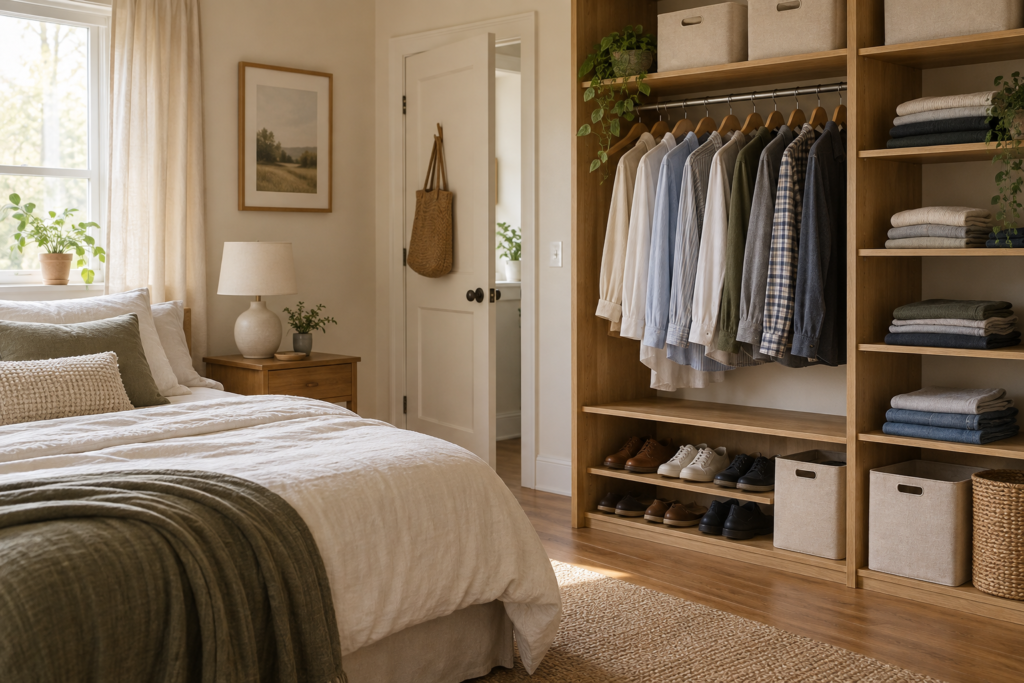
For small closet organization, divide the closet by clothing type and how often you use it. Give daily clothes the easiest reach, separate long hanging garments from short ones, use shelves or drawers for suitable folded items, and assign shoes and occasional clothing clear boundaries. Measure each zone with the actual garments before buying organizers.
A small closet works when you can see what belongs there, take out one item without disturbing several others, and return clean clothing without a lengthy reset. Filling every gap is not the same as making the space useful. A hanging shelf that blocks long dresses or a shoe rack that prevents a door closing may add compartments while reducing access.
This guide helps you build a practical layout using the clothes and furniture you already have. It then compares hangers, shelf dividers, hanging organizers, drawers, and shoe storage by their intended jobs. These are planning comparisons rather than hands-on product reviews. You can read more about that distinction in our editorial policy.
Start with the clothing that needs to fit
Work through one category at a time if emptying the entire closet would leave an unmanageable pile. Gather everyday tops, trousers, long garments, knitwear, shoes, and accessories separately. Include clean clothing waiting to be put away; otherwise you will design a layout for a smaller quantity than the closet normally holds.
Distinguish clothing you currently wear from occasional items and items awaiting a decision. The aim is not to reach a universal item count. A uniformed worker, a person with several formal commitments, and someone working from home may need different categories and proportions. Your storage should reflect your own routine rather than the contents of a styled photograph.
Give decision items a temporary process
Set aside garments needing repair, a fit decision, or a different storage location. Label the group with the action required rather than calling it miscellaneous. Choose a realistic time to deal with it. If decision items immediately return to the prime hanging area, they continue consuming the easiest space without supporting everyday dressing.
Do not treat valuable, delicate, or unfamiliar garments as ordinary storage items without checking their care instructions. Fabric construction and garment shape affect whether folding or hanging is appropriate. This guide helps allocate space; the garment’s care guidance should determine how a particular item is handled.
Measure the closet with the clothes inside the plan
Record the internal width, depth, and height, then measure the doorway separately. Include hinges, sliding-door overlap, fixed shelves, and the position of rails. A closet with sliding doors may expose only part of the interior at one time. An organizer that fits across the whole width may still be difficult to access through that smaller opening.
Measure hanging drop
Hang a representative long garment and measure from the rail to its lowest point. Do the same with the short garments you intend to group together. Include the hanger in that measurement. This tells you whether space below a short-hanging section can accommodate shoes or a small unit without brushing the clothes.
For example, suppose a short-hanging group needs 92 cm from rail to garment hem and the available space below the rail is 140 cm. That leaves 48 cm before accounting for practical clearance and any existing base or shelf. These are illustrative figures, not standard garment dimensions. Measure your actual items and test access before placing a unit beneath them.
Measure folded stacks and shelf access
Fold several representative items the way you realistically maintain them, then measure the stack’s footprint. Do not choose a folding method that takes more time than you will consistently spend. Shelf depth matters: two rows of folded clothing may fit, but the back row can disappear unless it has a specific occasional-use purpose.
Measure the clearance needed to lift an item off a shelf or remove a bin. Containers on a high shelf must be manageable from your normal position, not merely fit in the opening. Follow the furniture and organizer manufacturer’s load and installation requirements. Avoid adding extra rails or hanging storage on the assumption that the existing structure can support any additional weight.
Create five zones with clear jobs
Zone 1: daily hanging clothes
Give frequently worn hanging items the easiest access. Group them in a way that matches how you get dressed: by garment type, by work and casual clothing, or by another simple distinction you use daily. Colour sorting is optional. It may help visual scanning, but it will not fix a rail so crowded that removing one hanger pulls several others along.
Leave enough practical movement for hangers to separate. Rather than applying a universal spacing rule, test taking out and returning a typical item. If the process requires compressing the whole rail, review the quantity or move an appropriate category elsewhere. A slim hanger may reduce bulk, but it cannot make unlimited clothing comfortable to retrieve.
Zone 2: long garments
Reserve an uninterrupted drop for dresses, coats, or other long clothing that should hang. Keep boxes and shoe units out of that space unless the clothes have adequate clearance. Mixing long and short garments across the entire rail can make the floor difficult to use because there is no consistently open area beneath the short items.
Place the long zone where the closet’s structure provides the necessary height and an accessible opening. Do not select a double-rail accessory until you have checked where long garments would go afterwards. A second rail can add hanging capacity while removing the only suitable location for clothing that needs a full drop.
Zone 3: folded clothing
Use drawers, shelves, or appropriate bins for garments that suit folding. Keep stacks shallow enough to remove an item without toppling the rest. In drawers, an upright arrangement may improve visibility for some clothing, but it is a choice to test rather than a requirement. The fold should suit both the garment and the way the household returns laundry.
Give each category a boundary. A drawer divider or shelf divider can help maintain that boundary, but it is not always necessary. Start by assigning a defined section and observe whether the clothes stay within it. Buy a divider only if shifting or collapsing remains a recurring problem.
Zone 4: shoes and small accessories
Decide which shoes belong in the closet and which need a different daily return location. Measure the largest pairs, including boots, rather than using a small sample shoe to judge a rack. Keep pairs accessible without relying on an unstable stack. The floor zone should not block hanging garments or prevent the closet doors from closing.
Group small accessories by how you choose them. Belts may need a clear hanging section or a divided drawer; scarves may work in a shallow bin if the material and care needs permit. Avoid one deep accessory basket that becomes a mixed pile. An accessory organizer succeeds when you can locate the item from your usual viewing angle.
Zone 5: occasional and seasonal clothing
Store suitable occasional items outside the prime daily zone, with clear labels and a manageable retrieval method. Check garment care instructions before packing and use appropriate storage conditions. Do not assume that a compression bag or sealed plastic box is right for every textile. Delicate pieces may require more specific guidance than a general organization article can provide.
If seasonal clothing moves elsewhere, record the location simply enough that another household member can find it. A label such as “winter knitwear, bedroom shelf” is more useful than an unmarked matching box. Review the seasonal zone when your needs change so forgotten items do not accumulate indefinitely.
Choose a layout that fits the closet structure
Single rail with a top shelf
Keep long garments together at one end and short garments together at the other. Use any genuinely clear space beneath the short group for suitable shoes or a removable unit. The upper shelf can hold manageable occasional-use items, while the most frequently needed clothing remains within easier reach. Test whether the door opening permits removing the proposed lower unit or bins.
This layout often benefits more from clear category boundaries than from an additional hanging shelf. A fabric organizer suspended from the rail uses some of the same rail width that clothes need. Calculate that trade-off with your actual clothing before buying one simply because the closet lacks drawers.
Two narrow sections or a divided wardrobe
Give each section a clear role based on its measurements. One might serve hanging clothing and the other folded items, or each person might receive a defined section in a shared wardrobe. Avoid forcing equal arrangements when the clothing needs differ. A person with several long garments requires a different vertical allocation from one who mainly stores short tops.
Check each doorway and hinge separately. Matching bins may fit one side but not the other if fittings differ. Use consistent labels if that helps the household, while allowing the storage formats to vary. Consistency in where things belong matters more than every compartment looking identical.
Shared closet with limited width
Agree on personal zones and any shared zones before buying organizers. Label occasional or reserve areas so one person’s empty-looking shelf does not gradually become overflow for everyone. Review laundry return together: each person should be able to put clothing away without reorganizing another person’s section.
Where one person has accessibility needs, give suitable reachable storage priority over a symmetrical split. Daily use should determine the arrangement. A shared closet is easier to maintain when the boundaries are clear and the storage method does not require everyone to fold or hang in an unusually precise way.
Compare small-closet organizers before buying
| Organizer | Useful for | Main limitation | Check |
|---|---|---|---|
| Slim hangers | Reducing bulky hanger profiles | May not suit every garment’s shape or weight | Shoulder shape, grip, intended garment use |
| Shelf dividers | Supporting boundaries between folded stacks | Need a compatible shelf | Shelf thickness, attachment, clearance |
| Hanging fabric shelves | Adding compartments beneath a rail | Consume hanging width and add rail load | Dimensions, rated capacity, support method |
| Small drawer unit | Keeping folded categories contained | Needs opening space and may block clothing | Height, drawer extension, installation requirements |
| Shoe rack | Separating pairs at floor level | Boots and large shoes may not fit | Actual pair dimensions and garment clearance |
| Labelled storage bin | Keeping occasional categories identifiable | Can hide forgotten items | Contents’ care needs, loaded handling, access |
Read dimensions as a complete installation
Check whether a listing gives assembled dimensions or package dimensions. Include hooks above a hanging organizer, handles on a bin, and the extension of an open drawer. A unit that occupies all available depth may stop the closet door closing even though the main box seems to fit. Use the manufacturer diagram where available.
For a worldwide purchase, compare the same units. One inch is 2.54 centimetres. Convert measurements before comparing models, and verify the exact variant sold in your country. Similar product names can refer to different sizes or included accessories. Review the current return conditions, particularly when fit depends on an unusual wardrobe opening.
Buy one solution for one recurring issue
If folded stacks collapse, test a suitable divider. If accessories disappear, try a shallow divided container. If the rail remains overcrowded after sorting, changing hanger profiles may help, but review the clothing quantity and category allocation too. Avoid purchasing a complete storage system before you know which part of the existing layout fails.
Compare products using our storage buying criteria. This guide does not assign ratings or claim tests of particular brands. A useful shortlist should state who each product suits, the exact dimensions that matter, and the limitation that might rule it out in your closet.
Test the layout when clean laundry returns
The hardest moment for a closet is often after laundry, not while choosing an outfit. Bring back a normal load and put it away using the new boundaries. Notice where you hesitate, where a stack becomes too tall, and where you leave clothing on a chair because returning it is inconvenient. Those points tell you what needs adjustment.
Move the affected boundary or reduce the steps. A folded category might need a shallower stack, a drawer might need fewer subdivisions, or a rail section might need more width. Avoid changing every zone simultaneously. One targeted adjustment lets you see whether the underlying problem improved.
Create a place for clothes between uses
If you routinely keep some garments separate between wearing and laundering, give that routine a defined location appropriate to the clothing and your household. Without a boundary, the chair or closet floor tends to become the default. Keep this area limited and review it regularly so it does not become a second untracked wardrobe.
Do not mix damp items into packed clothing storage. Follow garment care instructions and use an appropriate drying routine before returning items. The closet should support the care process, not become a substitute for it. Keep any repair or cleaning decisions in their identified temporary group rather than hiding them in the daily section.
Common layout mistakes and their corrections
Long clothes cover every floor compartment: gather long garments into a dedicated drop zone and reassess the remaining floor area. Top-shelf bins are too heavy: reduce their contents or move the category to a more manageable location. A handle does not make an overloaded container easy to retrieve.
Hanging shelves sag or twist: check loading, assembly, and the manufacturer’s requirements; do not keep adding weight. Matching hangers still feel crowded: review rail quantity and the width assigned to each category. Folded clothes disappear behind the front row: keep everyday clothing visible and give any rear area a clearly defined occasional-use purpose.
Questions about small closet organization
How many zones should a small closet have?
Use only as many as your clothing and routine need. Daily hanging, long garments, folded clothes, shoes or accessories, and occasional storage are useful starting categories, but some can be combined. Too many tiny subdivisions can make putting laundry away harder rather than easier.
Are slim hangers always the best choice?
No. Their narrower profile may reduce hanger bulk, but the shape, grip, and intended weight must suit the garments. Choose appropriate support for each clothing type. Replacing hangers does not resolve a closet whose contents substantially exceed the space needed for comfortable access.
Should sweaters be folded or hung?
Follow the garment’s care guidance and consider its construction and shape. Different knitwear can respond differently to storage methods. If folding is appropriate, use a manageable stack or drawer section rather than compressing every item into a deep, unstable pile.
Can a hanging organizer replace drawers?
It can provide compartments for suitable items, but it consumes rail width and adds weight to the support. Compare its capacity and access with a small drawer unit or existing shelves. Measure the clothing space lost before deciding that the extra compartments are a net improvement.
How do I keep a shared closet organized?
Agree on clear personal and shared boundaries, use labels where helpful, and test the arrangement when both people’s clean laundry returns. Allocate space according to clothing and accessibility needs. A system that depends on one person continually correcting everyone else’s placement needs simpler rules.