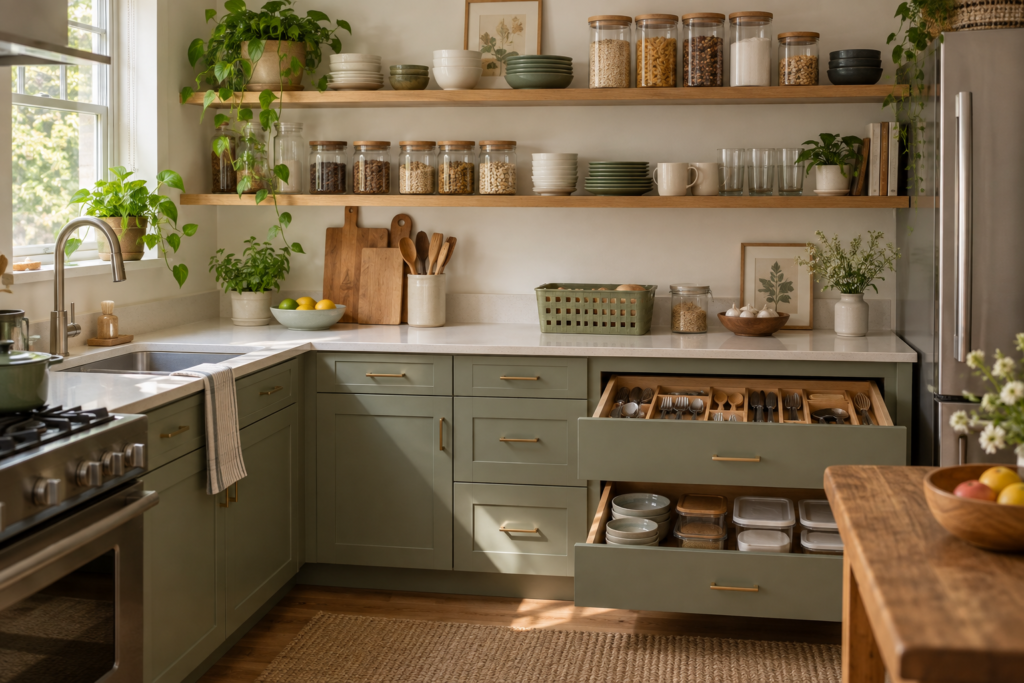
A pot lid organizer must support the lid and accommodate its handle while leaving room to remove it. Measure actual lids and the filled arrangement.
Make a lid inventory
Pot lids rarely form a row of flat plates. Knobs project, handles vary and one broad lid can push others out of alignment. Match each lid to a pot you still use. Do not keep unidentified spare lids just because a new rack offers extra slots.
Record diameter, lid thickness and handle projection. Treat unusually heavy or delicate lids according to their own care instructions. Measure the cabinet at its narrowest usable point, including hinges and internal shelves. An empty rack's dimensions do not describe the footprint when filled.
Compare placement options
An upright shelf rack can show each lid edge, but needs suitable slot spacing, stability and lifting clearance. A drawer provides access from above, but the knobs must fit beneath the drawer opening. A door-mounted holder uses a shallow zone, but may collide with shelves or stored items.
Read the exact door holder mounting method and loaded weight requirements. Cabinet doors differ in construction and hinge capacity. Obtain any required rental consent before drilling. Do not substitute adhesive mounting for specified fixings.
Test removal before buying
Use the actual cold lid or a cardboard outline to model removal. Can you reach the handle? Does the widest lid catch the shelf above? Can one lid come out without lifting two others? A little clear space may be more useful than an additional slot.
For drawer storage, close the drawer gently in the trial arrangement. If the knob touches the frame, change the layout. Never force closure to create clearance. Check that the organizer stays in its intended position when the drawer moves.
Make the routine easy to maintain
Choose surfaces you can clean according to their instructions. Let washed lids dry before storage. Narrow inaccessible grooves can make a complicated rack harder to maintain than a simple supported section.
Put the daily lid in the easiest position, even if the others are arranged differently. Keeping a compatible lid with its pot may remove the need for a separate organizer. Judge the arrangement by how quickly a lid is found and returned during cooking, rather than whether all handles face the same way.
Match each working lid before planning the rack
Gather the lid group you actually need to organise and connect each piece to its confirmed pot or recognised use. Keep an uncertain match distinguishable until appropriate product information resolves it. A lid’s diameter alone does not establish that it belongs to a particular pot. The inventory should show the working relationships rather than count every spare found in the cupboard as a required member of the same collection. This can reveal that the household’s main problem is identification instead of a shortage of slots.
Give each unusual profile a useful description, including features that affect storage and retrieval. A projecting handle, broad rim or different support requirement can change the occupied layout. Keep those observations connected to the relevant product instructions. The aim is to select the intended lid without guessing from a mixed row. Once the relationships are clear, compare appropriate locations for the complete group rather than buying a rack whose apparent capacity depends on ignoring the pieces that occupy a different shape.
Measure the occupied arrangement in more than one direction
An upright lid occupies room through its handle and profile as well as its broad face. Record the dimensions relevant to the intended rack and the route out of the cupboard. A slot can accommodate the edge while adjacent handles conflict. A drawer can appear deep enough at rest while its opening limits the actual movement. Compare the complete shape with the usable opening, keeping product suitability and installation requirements separate from the simple dimension sketch.
Consider the neighbouring lids in the same arrangement. The daily working piece should not require removal of several occasional pieces solely because its outline was counted last. Sketch a recognised retrieval sequence and leave the space required by that movement. Follow the actual fitting information for support and loading questions. Do not use the lids to prove an undocumented rating. A useful measurement note identifies which piece created the conflict and what information is still needed to choose an appropriate storage arrangement.
Worked example: a rack with enough slots but no handle room
Imagine a household counting five working lids and finding a rack advertised with five slots. The slot count appears sufficient, but two handles project into neighbouring positions. In this hypothetical example, the household compares the occupied profiles and removal route before buying. It considers a different appropriate arrangement or location using the actual product requirements. The example illustrates why a number of slots is not the same as demonstrated compatibility with the particular lid collection.
The household also checks whether the intended user can identify and remove the daily lid while the whole group is present. A trial with only the unusual pieces would not represent the final row. No universal rack orientation or support method is inferred from this example. Different lids and cupboards may lead to another choice. The useful decision combines confirmed pot relationships, occupied shapes and a complete retrieval route, so the organiser solves a described problem rather than simply adding an attractive row of empty spaces.
Compare a separate rack with the pot’s recognised home
Keeping a suitable lid with its pot may be an appropriate option where the products, space and routine allow. A separate rack may be useful where it improves identification or access. Compare those alternatives using the actual working relationships and relevant requirements instead of choosing a method from appearance alone. The question is where the intended lid can be found and returned reliably during the household’s ordinary preparation route. Different pieces can have different appropriate destinations.
Make the relationship visible when the lid and pot live separately. A clear group description or location cue can prevent another person from searching through unrelated cookware. Avoid an intricate numbering system unless the household genuinely uses it. Update the cue when a pot leaves the collection or a different lid enters it. The arrangement should keep confirmed working pieces distinguishable from uncertain spares, so a storage location does not silently imply that every piece in the rack belongs to a pot still in use.
Review the return after the required care
A lid should return through the appropriate care process described by its actual information. Give the confirmed working group a recognised home that accepts the pieces when that process is complete. If the rack appears suitable only when several lids are elsewhere, its layout has not been assessed for the full group. Notice the specific piece that repeatedly returns to another location. The problem may be handle interference, unclear pot identity or an inaccessible position rather than lack of overall cupboard capacity.
Change that described issue before adding more equipment. If a proposed holder involves a cabinet door or another installation condition, use the documented requirements and appropriate assessment for the actual setting. A different mounting method should not be assumed equivalent because it looks simpler. Keep technical uncertainty visible while improving the inventory and group relationships that can already be clarified. The storage system becomes easier to maintain when people know which lid belongs where and which separate question must be answered before a fitting is considered suitable.
Use a clear buying brief instead of a capacity label
List the confirmed working lids, relevant profiles, usable cupboard opening and the particular retrieval difficulty. Include the exact organiser’s intended use and installation requirements in the comparison. A marketing image of similar cookware does not establish compatibility with your own collection. Record any unanswered question and seek appropriate clarification. This makes a purchase review concrete: it explains which real group needs a better home and what the proposed equipment is expected to change.
Keep the review accurate about evidence. Comparing specifications is not a hands-on product test, and this guide does not certify an installation or capacity. A layout adjustment may solve the original issue without buying another rack. If equipment remains necessary, choose against the complete working route and the current confirmed relationships. After the change, update the location cues and remove obsolete match notes. The aim is an identifiable lid group that people can use and return, with appropriate support and access grounded in the actual products.
What matters more than the advertised number of slots?
Check the occupied lid profiles, handle space, usable opening and documented suitability for the intended arrangement. The slot count is one piece of information, not a confirmation that the collection fits or can be retrieved comfortably. Include the whole working group and its return route, while keeping uncertain lid-to-pot matches separate. A useful comparison explains the specific difficulty the rack should solve. If that difficulty is identification rather than capacity, clarifying the confirmed relationships may be more effective than adding another holder to an already ambiguous cupboard.
Common questions
Can a plate rack hold any pot lid?
No. Handles and lid profiles can need different spacing and support.
Is a door holder always the best space saver?
No. Check hinges, shelves, mounting requirements and the closing path.
Explore our Kitchen & Pantry guides, the buying checklist and all home organization guides.