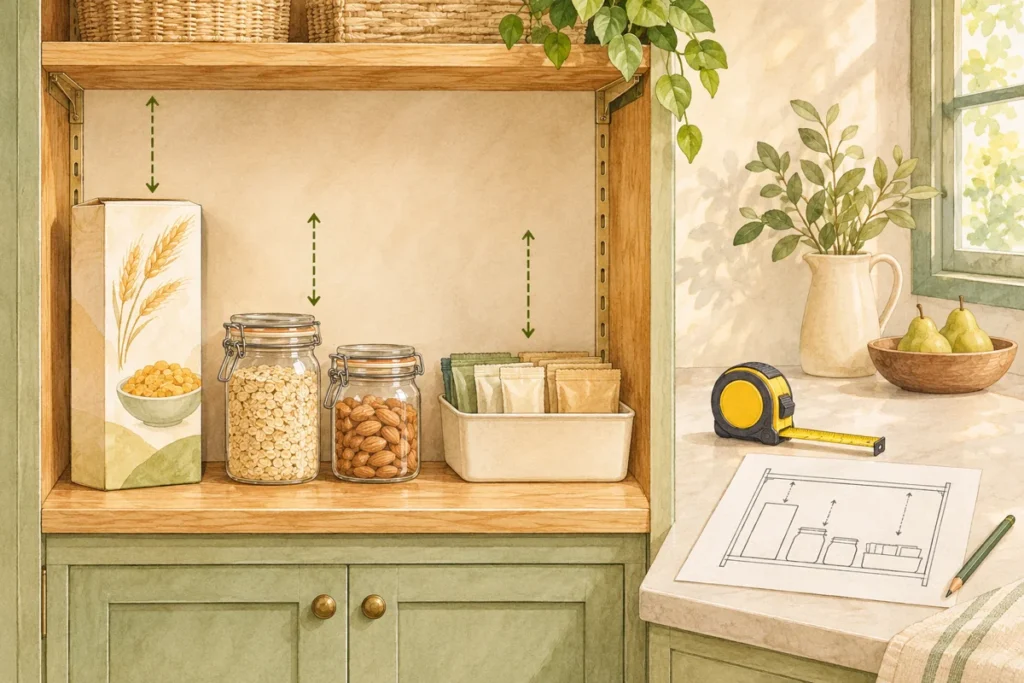
Measure your actual packages before choosing shelf spacing. Check the rating and installation requirements of the complete shelving system, then test how items will be retrieved without moving unrelated stock.
Inventory packages before measuring the room
Make a short list of the items your pantry must hold at the same time. Record an ordinary grocery week rather than an idealized collection of matching containers. Tall cereal boxes, unopened oil bottles and a mixing bowl need different openings even when their outside footprints look similar.
Separate frequently used food from occasional equipment and reserve purchases. This is a storage planning distinction, not an instruction to put every heavy item at a particular height. Accessibility, stability and the documented requirements of your system must all be considered together.
Measure openings and removal space
Record the usable shelf width and depth, excluding posts or brackets that obstruct packages. Measure the clear vertical opening rather than the distance between the top surfaces of two shelves. The thickness of a shelf can make those measurements quite different.
A container needs space to move as well as space to stand. Test the tallest package in its normal orientation: can you lift it clear of a lip, grip its lid and bring it forward? Leave clearance based on that action instead of using a universal extra-height rule that may not suit your products.
Read ratings as a complete system
Look for documented limits for the individual shelf and for the complete unit. Check whether the rating depends on evenly distributed loading, a particular configuration, specific brackets or required attachment to a wall. A number on a single component does not automatically establish the capacity of the installed arrangement.
Do not calculate a safe pantry load from appearance or shelf thickness. If the documentation does not describe your intended configuration, ask the manufacturer before buying. A shelf that fits between two walls still needs the mounting method specified for that product and the actual supporting surface.
Separate adjustable and freestanding choices
Adjustable shelving allows heights to change, but changes must remain within the system instructions. Confirm how shelves lock or sit in place, whether all supports must occupy matching positions and whether removing a shelf changes the permitted configuration. Retain the instructions for later adjustments.
A freestanding unit can require anchoring despite its name. The CPSC Anchor It campaign recommends securing furniture against tip-over. Follow the unit-specific instructions and use suitable installation help when needed. Placing heavier items low does not replace required anchoring.
Plan one accessible row before adding depth
Deep shelves can store a large amount while making half of it hard to retrieve. Sketch a front row for active packages and an identifiable reserve position if needed. Check whether the back row remains visible or requires a separate written inventory.
For example, a small household might keep one active breakfast package at the front and one unopened replacement behind it. A shelf filled with several unrelated rear items creates a different job: someone must continually move the front row. Reduce that problem before adding bins or another shelf.
Test the plan with your current storage
Arrange a small representative group on an existing surface with a marked outline of the proposed shelf. This checks package geometry and retrieval; it does not test structural capacity or replace installation requirements. Rehearse taking out the item you use most often.
Write down three measurements and three documentation checks before shopping. Compare products against the same brief. If a candidate is missing an internal dimension, load condition or mounting detail, treat that as unanswered rather than filling the gap with a guess.
Your planning worksheet
| Record | Measure or confirm | Reason |
|---|---|---|
| Tallest active package | Height plus actual removal movement | Choose a usable opening |
| Shelf opening | Clear width and depth around supports | Avoid relying on outside dimensions |
| Load documentation | Shelf and whole-unit limits and conditions | Check the intended configuration |
| Installation | Required fixing method and suitable surface | Plan the complete installation |
Turn the pantry inventory into a shelf brief
Create a brief for each proposed storage group. Write the ordinary quantity held at one time, the largest package dimensions, the main retrieval action, and any product information needed before choosing furniture. This keeps the design attached to a real grocery routine. A photograph of a well filled pantry may suggest an attractive arrangement, but it does not describe the packages your household purchases or the space needed to remove them. Use the same brief for all candidate systems so their advantages are compared fairly.
Distinguish current packages from intended future purchases. If you expect to buy larger quantities, record that as a proposed change rather than quietly designing around it. More reserve capacity can also require a clearer inventory routine, because hidden packages are difficult to account for. Decide whether the household actually needs that reserve before increasing shelf depth or adding another unit. The practical question is what can be stored, identified, and retrieved consistently under the documented conditions of the shelving system.
Plan a location for the awkward package first
Identify the package that is hardest to fit or remove: a tall box, a wide appliance used occasionally, or another ordinary pantry item with a projecting part. Test its geometry in the proposed opening before arranging smaller objects around it. This can reveal that a shelf needs different spacing or that the item needs a different suitable home. Do not shorten, alter, or remove required components from an appliance or container merely to make an attractive shelf plan work. Storage should accommodate the item’s actual intended form.
After the awkward item has a workable position, group the remaining packages according to use and retrieval. Keep the layout flexible within the shelf system’s permitted configurations. Temporary location labels can help during a trial, but they should not obscure product information or turn an undecided arrangement into a permanent assumption. If the package group changes substantially, revisit the measurements and relevant loading conditions rather than treating the original shelf plan as suitable for every later purchase.
Keep component information and whole-unit information together
When a system includes several parts, retain the information that establishes how they are intended to be used together. A shelf board, bracket, support rail, and fixing method are not interchangeable simply because their colours match. Record the exact model and proposed configuration before seeking clarification from the supplier. That makes the question specific enough to answer. Ask about your intended arrangement rather than requesting a general assurance that the product is strong or suitable for kitchens.
Do not convert a missing rating into a calculation based on material or price. Where the documentation leaves a requirement unresolved, note it clearly and obtain appropriate information or installation help. A layout sketch can show the places you want to store food, but it does not validate the supporting structure. Keep those two jobs separate in the record. Doing so also helps when another household member wants to adjust a level later and needs to understand the conditions that applied to the original configuration.
Worked example: improving access without adding depth
Imagine a hypothetical pantry where breakfast packages occupy the front of a deep shelf and baking supplies disappear behind them. The household initially wants a deeper unit to hold more stock. A retrieval trial shows that the problem is the mixed front and rear arrangement, not simply a shortage of area. The household assigns recognisable groups, reviews its ordinary reserve quantity, and compares suitable layouts using the actual package dimensions. Any new furniture remains subject to the documented load and installation requirements.
This example does not prove that shallow shelves are always preferable. A different household may have a justified need for more depth and an effective way to identify and retrieve rear items. The lesson is to describe the repeated interruption before choosing a product. Measure the effort needed to take out an ordinary package and return it, then decide whether another format solves that specific problem. Buying extra capacity without reviewing the access process can preserve the same inconvenience on a larger scale.
How do I know whether a pantry shelf plan is ready?
The plan is ready for purchase or installation only when the package dimensions, retrieval sequence, permitted configuration, loading conditions, and installation requirements are established for the intended system and location. Record unresolved questions and obtain the missing information. A mock layout helps test organisation but is not a structural test. After installation as directed, review the pantry in ordinary use and follow the relevant maintenance instructions. Keep product documentation available for later changes rather than relying on the appearance of the completed arrangement.
Common questions
Is deeper shelving always more efficient?
No. Capacity is useful only when you can identify and retrieve the items. Consider the effort required to reach the back row.
Can I move adjustable shelves freely?
Use only positions and configurations allowed by the system instructions. Check whether the adjustment changes other requirements.
Sources and further reading
- CPSC: Anchor It