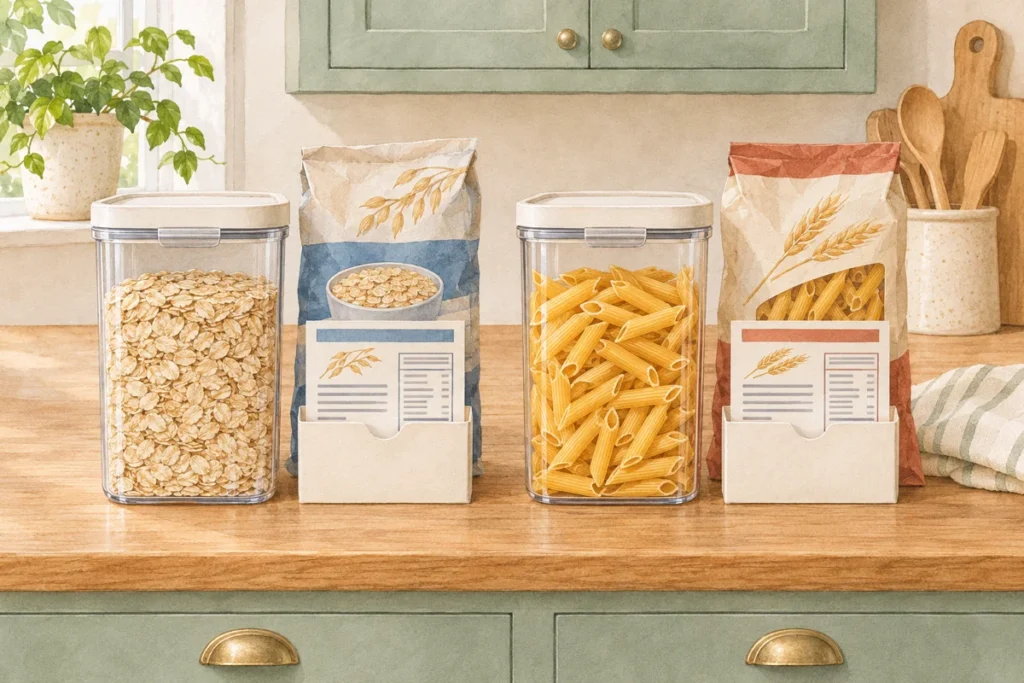
A useful pantry label identifies the exact food and helps you retrieve its original package information. Keep batches separate and do not let a decorative label replace ingredients, allergen or storage instructions.
Choose what actually needs decanting
Start with the food you use frequently and the problem its packaging creates. A torn bag that cannot stand upright may benefit from a suitable container. A package that already closes well and displays useful instructions may be easier to keep as it is. Matching jars are optional; readable information is not.
Consider how you buy and cook. If you regularly switch brands or buy different varieties, a permanent label such as flour may be too vague. Decide how the exact product name and its package record will stay associated with the food before emptying the bag.
Keep the original package record
Retain the ingredient list, allergen information, storage directions, preparation instructions, printed date and any batch or lot reference available on the packaging. An empty package can be kept separately from food in a clean, organized record area; a complete readable photograph is another option if it captures every relevant panel.
The FDA advises people with food allergies to read food labels. A homemade jar label cannot establish that a food is appropriate for someone with an allergy. Check the current original label for the exact product, because a familiar brand name alone does not identify every formulation.
Give each container a readable identity
Use the exact product name on the front where it is visible in its normal storage position. Add a reference to the original package record, such as OATS-04, and record when the container was filled. Keep printed package dates distinct from your own filling date so nobody mistakes one for the other.
Choose label size and contrast by testing the container on its actual shelf. Read it from the position where you normally retrieve food. A neat label on a lid is ineffective if the lid is hidden beneath another shelf. Use plain wording that every household member understands.
Refill without losing the history
Do not continually top up a container with new purchases while retaining one old label. Separate batches until the earlier contents have been used, then clean and dry the container according to its instructions before the next fill. Follow food-specific storage guidance rather than assuming that a new jar extends the printed date.
For example, two purchases of rolled oats can have different package details even when the product name matches. Keep the second package closed until the first batch is finished. Update the record when you start the second purchase, instead of assigning both batches the first package date.
Use two levels of labels
A shelf label can describe a broad household location: breakfast, baking or unopened stock. A food container label needs the more precise product identity. Keeping those jobs separate allows you to reorganize the shelf without repeatedly rewriting every container.
Removable labels may be useful when contents change, but check adhesive compatibility and removal instructions. Do not cover closures, seals, care markings or manufacturer instructions. There is no need to label every object: focus first on foods that could otherwise become unidentified.
Check the system during the next grocery put-away
Retrieve one original package record using only the jar label. Ask another household member to do the same. If either of you cannot find it promptly, simplify the reference system before decanting more foods. This test is more useful than buying a large printed label pack in advance.
Keep a small supply of blank labels near the record area and update the information as part of putting groceries away. If maintaining the records becomes impractical, store the product in its original packaging within an appropriate basket. The system should reduce uncertainty as well as visual clutter.
Your planning worksheet
| Location | Information to show | Purpose |
|---|---|---|
| Container front | Exact product name and record reference | Identify the contents |
| Package record | Original label, directions and batch details | Retrieve product-specific information |
| Household note | Filling date, clearly labelled | Distinguish household activity from printed dates |
| Shelf edge | Broad storage zone | Help put items away |
Build the record around the way you shop
A label system is easier to maintain when it follows an ordinary grocery purchase. Choose one frequently used food and write down what happens from arriving home to opening the package and using the contents. Identify the moment when information could become detached from the food. The solution may be a reference on the container, a clearly filed package record, or simply retaining the original packaging in suitable storage. Select the simplest method that preserves the association without requiring a separate research project each time groceries are put away.
Keep the record names specific enough to distinguish purchases. A household reference such as baking shelf describes a place, while a reference for the actual package describes the food in the container. Those names should not be used interchangeably. If you change the shelf layout, update the location information without accidentally assigning the old package record to a different purchase. Someone who did not create the labels should be able to understand which record belongs to the food currently present.
Check readability in the normal position
Place an empty candidate container in its intended position and read the proposed label from the ordinary viewing angle. Notice whether a shelf edge, another container, or the container’s own shape obscures the wording. A front label can be practical on one shelf while a different position works better elsewhere. There is no need to prescribe one universal font size: test the actual wording, contrast, viewing distance, and household needs. Keep essential identity information easy to recognise without turning every jar into a dense notice.
Separate the brief visible label from the complete package record. The label helps retrieve the right information; it does not need to reproduce every panel in tiny lettering. When using a photograph, check that the relevant information is readable and that the record remains accessible to the people preparing food. If your chosen method is too cumbersome to maintain, return to original packaging rather than accepting a system in which the food looks identified but its supporting information cannot be located.
Make changes visible when a container is reused
Decide how an old label is removed or updated before the next food is placed in the container. Check the container and label manufacturer’s care and compatibility information. Do not leave conflicting labels on different sides and expect the household to remember which one applies. A container with an uncertain identity needs that uncertainty resolved before its contents are treated as a particular food. The appearance of familiar grains or powders is not an adequate replacement for a reliable record of what was placed there.
A small update station can hold the ordinary items needed for the record process, such as blank labels and the chosen reference list. Keep it separate from the food itself and appropriate for the location. The point is convenient maintenance, not another decorative purchase. When putting away a new batch, check the association between the visible identity and its record before moving on to the next item. A brief consistent check is more useful than periodically relabelling an entire shelf without addressing how errors arose.
Worked example: one container, two purchases
Consider a hypothetical household that buys the same kind of oats twice, from different packages. Its old method uses one permanent oats label and stores package photographs without names. During a review, nobody can reliably identify which photograph belongs to the current contents. The household changes the method so the container refers to one clearly named package record, and the later purchase remains separately identifiable until it is used. This is an information organisation example, not a food storage experiment or a safety certification.
The useful change in this example is the link between the current food and its information. Matching jars are irrelevant to that link. Another household may decide that the original package inside suitable storage is easier to maintain, particularly when products change frequently. Both choices should preserve the information needed for the actual food and follow its applicable guidance. Do not interpret the example as advice that transferring food extends its usability or overrides a package’s storage directions.
What should a homemade pantry label include?
Use a clear identity for the exact contents and an understandable reference to their original package information. Keep your own filling date distinct from dates printed on the package. Check that the label can be read where the container is stored and that another household member can retrieve the associated record. Follow the actual food and container requirements. A homemade label is an organisation aid; it does not establish allergen suitability, replace the complete original food label, or certify the condition of unidentified contents.
Common questions
Can I copy only the product name?
A name helps identification, but retain the original package information as well. A short homemade label is not a replacement for the complete food label.
Should all pantry containers have matching labels?
Matching appearance is optional. Prioritize readable wording, accurate information and a refill process you can maintain.
Sources and further reading
- FDA: Food Allergies