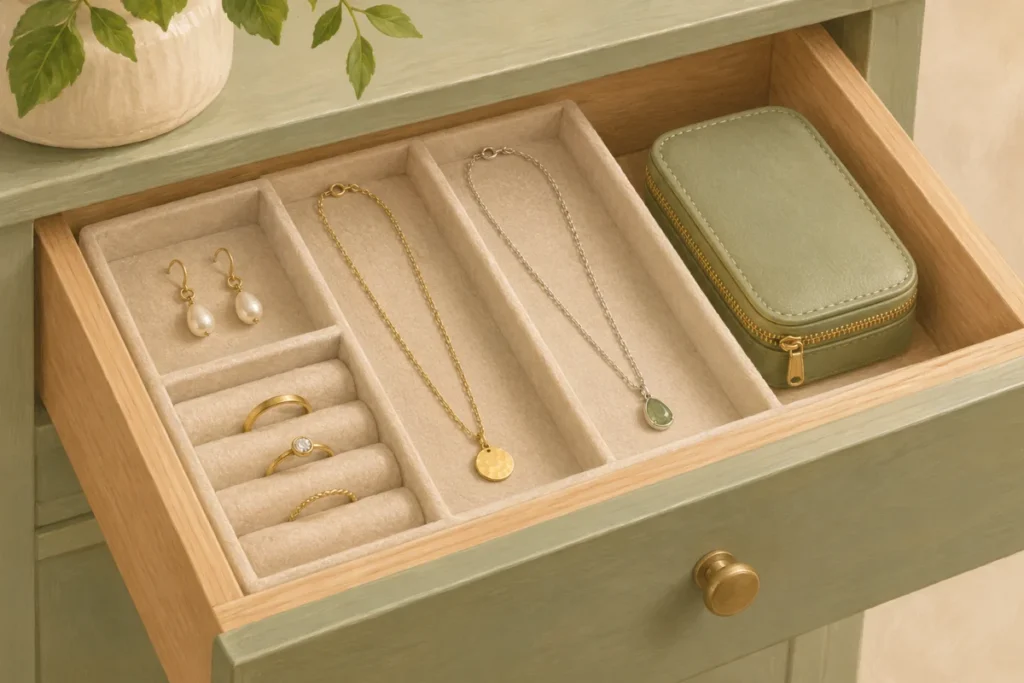
Separate chains, keep pairs together and give daily pieces an easy return point. Match the holder and environment to the jewelry maker's material-specific care instructions.
Sort by handling needs
A single large bowl can collect jewelry quickly but may make finding one pair awkward. Start by separating chains, earrings, rings and pieces worn daily. Keep sets or pairs together and identify damaged clasps before deciding how much storage is needed.
Different materials can require different care. Ask the jeweler or maker about suitable conditions, contact surfaces and cleaning. Do not assume that one lining, pouch or moisture-control product suits every metal, stone or adhesive.
Give chains their own space
Compare flat divided storage, individual pouches and suitable hanging holders. The aim is to remove one chain without pulling several others with it. Check the length of your chains against the available compartment or hanging clearance.
Try an arrangement with the actual pieces before buying. A hook that looks small enough may be too thick for a clasp or may leave a pendant dragging on the surface below. Follow the item's care guidance and avoid tightly stretching a piece to make it fit.
Keep pairs visibly together
Use a compartment or holder that keeps each pair identifiable and accommodates the back or fastening. Check removal access with your fingers. Tiny compartments are not useful if they make ordinary retrieval difficult.
Reserve a limited daily group near the dressing routine, in a suitable secure place. Return pieces after use rather than letting temporary piles spread across several rooms. Keep valuable items according to your own security needs; a decorative display is not secure storage.
Choose the holder by filled dimensions
Measure the drawer opening and usable depth, including the lid or cover of a jewelry box. Check whether the tray can be removed for cleaning. For a wall-mounted display, use the specified mounting method and obtain any required rental consent.
Trial one tray or pouch format before buying a large set. If frequently worn pieces still accumulate elsewhere, move the return point closer to the routine instead of increasing storage capacity. Inspect periodically for misplaced partners or fastenings. For heirloom or fragile jewelry, obtain specialist care advice rather than treating a general organizing guide as conservation instruction.
Separate identity, handling and appearance
Start by identifying which pieces belong to the daily selection and which have occasional, sentimental or unresolved roles. Keep ownership clear, especially where several people use the same dressing area. Appearance can help selection but does not establish material, construction or care requirements. Preserve the exact information relevant to the pieces and use appropriate maker or specialist guidance where a handling question is uncertain. The organisation method should make known pieces easier to identify rather than infer technical facts from how they look.
Group by the action needed to select and return the piece. A pair requires a clear relationship, while a chain has a different retrieval question from a larger item. Those differences can support separate appropriate homes without requiring every storage product to match. Avoid putting an uncertain piece in the confirmed daily group merely because an empty compartment is available. Resolve its identity or handling question separately. A smaller understandable collection is often more useful for organisation than a larger display where visual similarity conceals which items belong together.
Keep pair relationships visible
Choose an appropriate method that makes the two pieces of a recognised pair identifiable together, while respecting their actual requirements. A general compartment full of similar small pieces can conceal whether a pair is complete. Use the piece identity and the intended selection routine to define the group. Keep any supporting product’s documented use in the decision rather than assuming a holder is suitable from an attractive display of items that happen to resemble the collection.
Give an incomplete pair a clear exception status instead of silently mixing it with the ready group. A concise note can identify the recognised piece and the next search or ownership action. Remove the note when resolved and update the destination. The arrangement should help somebody select the intended pair without sorting unrelated pieces each time. It does not establish that an unmatched piece can be altered, combined or used in another way; those are separate decisions based on ownership and the actual item information.
Worked example: daily pieces hidden among keepsakes
Imagine a collection where daily choices share a deep container with occasional keepsakes and a few incomplete pairs. The wearer searches through every group to find a regular pair. In this hypothetical example, the household identifies an appropriate recognised home for daily selections, keeps the occasional group understandable and gives incomplete relationships a separate decision route. The change improves identity and access rather than assuming that a new matching tray can resolve the unresolved questions in the collection.
The wearer checks whether the ordinary selection can be made without disturbing unrelated pieces. The arrangement follows the actual care and supporting product information. This example does not recommend a universal holder, storage atmosphere or cleaning treatment for every material. Its useful lesson is that daily access, sentimental ownership and incomplete pair decisions are different roles. Making those roles visible can be more effective than placing the same mixed collection into additional small compartments that still conceal why each piece is present.
Connect the return point with the recognised home
Think about where the wearer normally removes the daily pieces and where they can appropriately return them. A destination elsewhere in the room may be visually neat but inconvenient in the actual routine, causing the same pieces to gather in another place. Describe that handoff before buying equipment. A temporary recognised point may be useful where appropriate, but it needs a clear relationship with the final home so it does not become a second unrecorded collection.
Keep different stages distinguishable when a piece requires separate care or assessment. A general catch-all destination should not make an unresolved item appear ready for ordinary selection. Follow the actual guidance for that item and identify the next action. When the action is complete, update the home and remove the obsolete note. The organisation process supports findability and accurate status while leaving material-specific treatment to appropriate information, rather than deriving a care method from the shape or label of the organiser.
Compare holders with the complete occupied collection
For a proposed holder or tray, compare its documented intended use and usable dimensions with the actual pieces and retrieval actions. Count the group when all assigned items are present, including those temporarily elsewhere. An accessory can appear suitable while partly empty yet create awkward selection when the whole collection returns. Keep product requirements central and mark an unanswered compatibility question instead of filling it with an assumption from a promotional photograph.
Identify what the proposed purchase should improve. It might clarify pairs, make a confirmed chain group more identifiable or provide an appropriate daily return home. Another tray will not solve an undecided ownership question or establish the material requirements of an uncertain piece. Resolve those information issues before buying capacity for them. Describe a specification review accurately as a comparison rather than a hands-on test. A useful choice supports known group identities, appropriate handling and a routine the wearer can maintain without repeatedly sorting an ambiguous mixed collection.
How can jewelry storage remain simple?
Use recognised groups based on actual selection and return, preserve relevant piece information and keep unresolved identities or pair relationships visible. Avoid subdivisions that look impressive but do not help the wearer find the intended item. Update a group when pieces enter, leave or change role. Follow appropriate guidance for the real material and construction instead of treating every item alike. A concise location cue and one clear exception action may be enough for ordinary organisation. The arrangement succeeds when the wearer can identify the intended piece, understand its current status and return it appropriately without relying on one person’s hidden memory of the collection. For a newly added piece, identify its owner and relevant care information before assigning the intended group and destination.
Check a tray against three real retrieval tasks
Use one frequently worn chain, one pair of earrings and one occasional piece to assess an existing storage area. Keep the chain’s own route distinguishable, give the pair an identifiable shared position, and place the occasional piece according to its actual care requirements. Then retrieve only the earrings. If that action disturbs the chain or hides the other earring, the divisions do not yet support the task. Change one boundary before buying a larger tray. This is a layout example rather than advice that different jewellery materials may touch or share a lining; follow the care guidance for each actual piece.
Common questions
Is open display suitable for every piece?
No. Material care, environment and security requirements differ.
Should every piece have a separate compartment?
Only when it helps retrieval and appropriate care. Keep the system simple enough to maintain.
Explore our Closet & Bedroom guides, the buying checklist and all home organization guides.