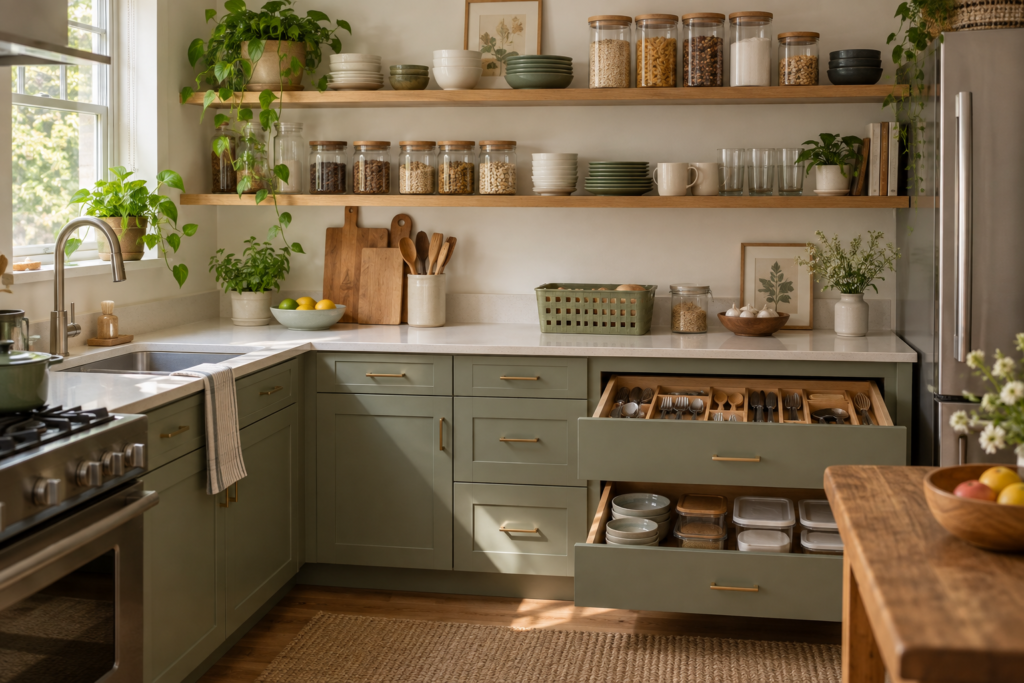
When baking-tray storage becomes awkward, identify whether the problem comes from the tray shape, organizer spacing or cabinet opening. Separate pieces that catch, reduce deep stacks, and test removal with the cupboard fully stocked. An organizer should support the bakeware without forcing rims, blocking handles or depending on every slot being full.
A baking cupboard can remain technically organized while being unpleasant to use. The right tray is visible but wedged behind a hinge. A cooling rack brings two pans out with it. A stack seems stable until the bottom sheet is needed. These are practical faults in access and compatibility, not simply a failure to put things away neatly.
This guide helps you isolate the cause and make a focused repair. If the whole collection is still unsorted, begin with the baking-tray setup guide. Here, take the problem that occurs most often and test one change at a time so you can see what actually improves the routine.
Reproduce the problem safely with cool, clean pieces
Do your assessment when the bakeware is ready for storage and the area is clear. Remove one piece using the movement that normally causes trouble. Notice where contact occurs: between two rims, against a divider, at the door hinge or under the shelf above. Do not keep pulling through resistance to prove the tray can eventually come out.
Then unload the immediate area and repeat the movement with only the problem piece present. If it still catches, the cabinet opening or organizer may be responsible. If the problem disappears, a neighbouring item is probably occupying the needed space. This simple comparison prevents you from replacing a rack when rearranging one pan would solve the issue.
Record the exact piece and movement rather than describing the entire cupboard as too small. “The muffin tin catches the second divider when lifted” gives a useful buying or adjustment criterion. “Need more storage” does not distinguish a width problem from a height or shape problem.
| Symptom | What to inspect | First repair to test |
|---|---|---|
| Tray catches in an upright slot | Rolled rim and divider spacing | Widen the section if the design permits |
| Cooling rack pulls another piece out | Projecting wires, feet and adjacent rims | Give racks a separate section |
| Bottom tray is difficult to reach | Depth of the horizontal stack | Split the stack by frequency of use |
| Upright row leans when partly empty | Support independent of neighbouring trays | Use a suitable divided configuration |
| Pan fits inside but will not come through the door easily | Opening width and hinge intrusion | Change location or orientation |
Trays jam between dividers
A tray’s flat centre may fit a slot while its rim does not. Measure the widest or deepest part of the profile, including rolled edges and handles. Also look at the angle required to lift the piece past the front of the organizer. The narrowest point in that path is the meaningful clearance.
If the organizer has adjustable dividers, widen the section using its intended configuration and test the tray again. Leave enough space for a comfortable grip as well as the tray itself. A slot that barely admits the metal may still be awkward for a person to use, particularly when another piece sits immediately beside it.
Do not bend dividers or force tray edges to make an unsuitable combination fit. If the rack’s fixed spacing conflicts with a regularly used piece, assign that piece another position or choose a better-fitting organizer. One wide section for specialty tins can be more useful than a full row of equal narrow slots.
Cooling racks hook into trays or one another
Cooling racks often have feet, wire ends or raised edges that behave differently from flat sheets. When stored together, these projections may catch a tray rim or the wires of a second rack. Observe the contact point instead of assuming the whole group simply needs a tighter arrangement.
Try a separate supported section for the racks and orient them so their projecting parts do not interlock. Check the removal path with the neighbouring trays in place. An arrangement that works with one rack may still catch when both are returned, so test the full group rather than a single sample.
If a rack must share a horizontal stack, evaluate whether it can be reached without dragging across other surfaces and follow the items’ care guidance. Do not add an improvised separator without considering whether it is suitable for the products and easy to maintain. The simplest repair is often separation rather than another layer inside the stack.
Horizontal stacks require too much lifting
The problem with a tall stack is usually not that the pieces fail to fit. It is that the desired item occupies a low position. Sort the stack by actual frequency of use and identify whether the broadest bottom piece is also the one you need most often. If so, the nesting logic is working against the cooking routine.
Split the collection into daily and occasional groups. A regularly used sheet may move to a supported upright position, while deep tins remain in a short stack. You do not have to convert the entire cabinet to one storage style. A mixed arrangement can reduce handling while preserving useful nesting where it works.
Check whether one oversized pan is forcing every other piece into a pile. Giving that pan a separate suitable location can release a surprising amount of working space. The gain comes from removing an obstruction, not necessarily reducing the number of useful pieces you own.
Upright trays lean or slide when a piece is removed
An upright row that relies on all trays pressing together may be stable only when full. During cooking, several pieces leave the cabinet and the remainder can lean into the gaps. Test the layout in that partly empty state. It should still support the remaining pieces within the organizer’s intended use.
Adjust suitable dividers to create independent sections where possible. Keep heavy or deep pans out of narrow slots intended for flatter pieces. The goal is not to compress the row tightly; it is to provide appropriate support without distorting the bakeware or making removal difficult.
If the entire organizer slides when a tray is taken out, inspect whether the tray catches the rack and pulls it along. A grip surface cannot fix inadequate slot clearance. Follow the organizer’s instructions for placement and any permitted anti-slip features, and resolve the contact causing movement before treating the shelf surface as the only problem.
The cabinet opening is narrower than the stored layout
A cabinet can have generous internal dimensions but a restricted doorway because of hinges, a centre stile or adjacent furniture. Measure the route through the opening with the actual tray. A piece that can be inserted at an angle during a major reorganization may not be convenient to retrieve every day once the cupboard is full.
Try changing the orientation only if the resulting movement remains comfortable and the piece is suitably supported. If the tray needs a precise sequence of tilting, lifting and shifting other objects, consider another location. A daily item should not require dismantling the neighbouring arrangement just to clear the door.
Do not alter cabinet hardware or cut organizer components simply because the internal shelf appears large enough. The furniture and organizer have their own installation requirements. Moving the storage assignment is often the more straightforward solution when the opening, rather than the shelf area, is the limiting factor.
The drawer closes but scrapes the bakeware
In a drawer, inspect both the highest stored point and the movement of the contents. A tray may shift upward or lean when the drawer accelerates, causing contact that is not visible while it is open. Close a small loaded trial gently and watch for movement instead of repeatedly pushing a full drawer through resistance.
Check handles and rolled rims as well as the broad tray surface. A low-profile piece can still have one corner that catches the cabinet frame. If the organizer raises everything too high, a lower arrangement or another drawer may be needed. Removing a small accessory from the top will not solve the problem if the rack itself exceeds usable clearance.
Keep drawer slides and closure mechanisms clear. Storage should operate within the furniture’s working space. If a tray must be flexed or forced to close the drawer, it does not fit that arrangement, regardless of how tidy the open drawer looks.
Surface contact makes the collection awkward to maintain
Different bakeware finishes have different care requirements. Follow the manufacturer’s advice about stacking and any protection needed between pieces. This guide does not assume that every pan can be stored directly against another or that one liner is appropriate for every coating.
From an organization perspective, excessive layers can make a stack difficult to use. If each retrieval requires removing several separators and rebuilding the order, consider a shallower stack or individual supported positions. The storage method should protect the pieces in a way that the household can realistically maintain.
Also make the shelf accessible for cleaning. A tightly packed cabinet can trap debris in corners that are difficult to reach. Leave enough practical room to remove the relevant group and inspect the area without dismantling every baking accessory in the kitchen.
A worked repair for a noisy, catching cabinet
Imagine three flat sheets, a muffin tin and two cooling racks stored upright in equal narrow slots. The owner reports that the organizer moves whenever the muffin tin is removed and that the cooling racks rattle into the sheets. Inspection reveals two separate causes: the muffin tin’s rim is wider than its slot, and the cooling-rack feet hook the neighbouring edges.
The repair gives the muffin tin a wider section using the rack’s approved adjustment method. The cooling racks move to their own supported position, with projections oriented away from the sheets. The three flat trays retain narrow individual sections because those already work well. No change is made merely for symmetry.
After the next cooking session, the partly empty row is checked again. One sheet leans too far because its divider was moved during the adjustment, so that section is corrected. The final test covers both full and partial occupancy, which is more informative than a single photograph of the completed cabinet.
Know when a new organizer would actually help
Before comparing products, photograph or sketch the contact point and write the necessary clearance beside it. This small record prevents the original problem from becoming vague once you start browsing attractive alternatives. If the trouble involves the cabinet opening, include that dimension as well as the shelf width. A replacement with more slots will not fix a narrow doorway, while a wider slot may resolve a rim conflict without changing the rest of the cabinet at all.
A replacement is useful when the existing rack has fixed dimensions that repeatedly conflict with necessary bakeware. Record the required slot width, height and depth, plus the cabinet opening and grip space. These measurements turn an irritating symptom into a concrete specification you can compare against a listing.
Ask whether a simpler solution would do the same job. A suitable divider separating two broad groups may be more practical than a rack with many fixed slots. An occasional roasting tin may need relocation rather than a larger organizer that crowds the everyday collection. Browse the kitchen and pantry guides if nearby zones could release a better location.
Sources and practical checks
Where nesting is permitted, check surface protection too. Nordic Ware Bundt care guidance recommends a light fabric layer between stacked Bundt pans. That is a named example, not a rule for every baking tray; consult your own cookware instructions.
Frequently asked questions about baking tray storage
Why does a tray fit when empty but jam in a full cabinet?
Neighbouring pieces may occupy the space needed to grip, tilt or lift it. Test the removal path with the full collection in place. The relevant measurement includes working clearance, not just the tray’s resting footprint.
Can I solve sliding by adding a liner?
A suitable liner may help in some permitted arrangements, but first check whether a tray is catching and dragging the organizer. A liner cannot create missing slot width or repair an unstable frame. Follow the organizer and cabinet care instructions.
Should deep roasting tins go upright?
Only when the storage product and cabinet support that intended use comfortably. Deep pans may work better in a shallow stack or individual shelf position. Compare balance, grip and retrieval rather than assuming the direction used for flat sheets suits every pan.
Why does the system fail after someone else puts trays away?
The categories may depend on a precise order that is not obvious. Use clearer functional sections and more forgiving spacing where possible. If one piece belongs in a special position because of its shape, make that distinction easy to see.
When is the repair complete?
Test an ordinary cooking session and the return of all clean pieces. The trays should remain supported when some are absent, and each regular item should come out without pulling its neighbours. If the same catch returns, inspect that contact point rather than reorganizing the entire cupboard again.
For the wider room layout, explore our small kitchen ideas and keep cabinet access, preparation surfaces and this storage area working together.