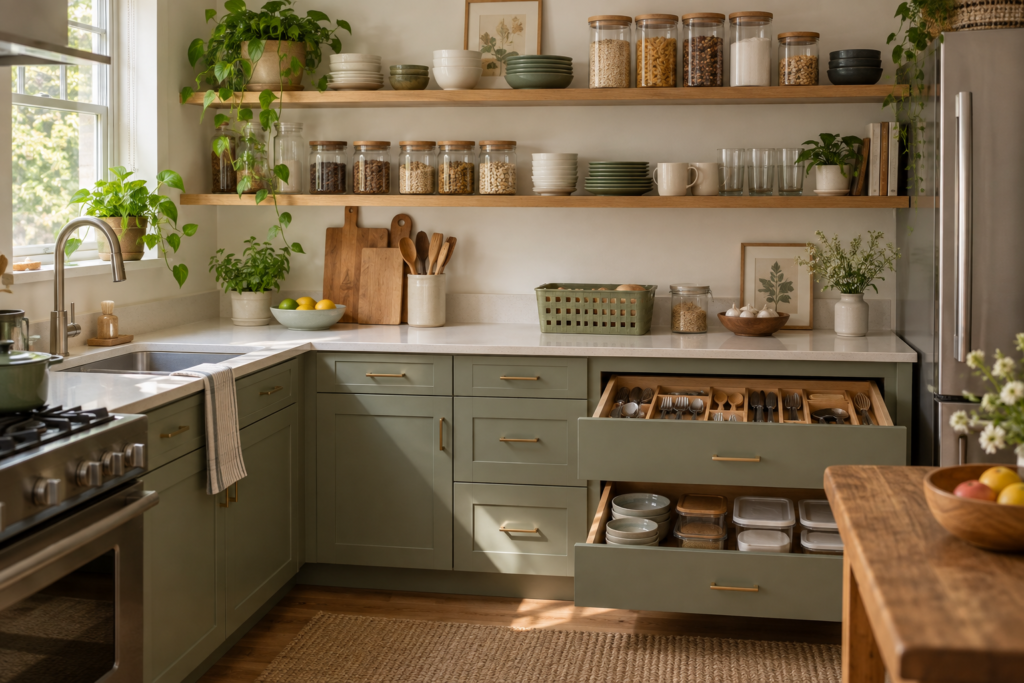
Compare the organizer with the usable cabinet opening and its full movement, not only the cabinet width. Hinges, door angle, mounting requirements and the space in front can determine whether it works.
Identify the cabinet opening that matters
Open the door to the position you can use during normal cooking. Measure the clear opening between obstructions, including hinges and any center stile. Then measure the internal cabinet separately. A wide interior can sit behind a much narrower entrance.
Check whether the intended organizer moves through that opening at every point in its travel. A basket that fits while empty may carry handles, bottles or packets beyond its sides. Include the actual contents in your planning rather than treating the wire frame as the entire footprint.
Distinguish mounting types
Some organizers attach to the cabinet base; others depend on side-mounted runners, a door connection or a specific cabinet construction. These are different installation systems. Read the exact mounting instructions and supplied hardware list before comparing products.
Do not assume that a thin removable shelf or an unknown cabinet panel provides a suitable fixing surface. If the instructions do not cover your cabinet construction, ask the manufacturer or an appropriate installer. Avoid adding improvised reinforcement based on a generic online tip.
Measure travel outside the cabinet
A pull-out needs room in front for the extended organizer and for the person using it. Check nearby appliances, another open cupboard, a kitchen island and the usual walking route. A unit that opens fully only when several other doors are shut may be inconvenient in daily use.
Mark the proposed extended footprint on the floor with a removable method appropriate for the finish. Rehearse retrieving an item without stepping into an awkward corner. This simple layout test is particularly helpful when two cabinets face each other.
Check contents against the moving opening
List the tallest and widest objects you intend to carry. Compare their dimensions with the basket opening and available vertical clearance. A bottle nozzle or a projecting handle can be the part that catches even though the main object appears to fit.
For a two-level organizer, check access to each tier separately. The upper basket should not prevent you from lifting items from the lower one. Choose the arrangement around the objects you actually use; do not purchase smaller replacement supplies merely to justify a storage accessory.
Read the permitted load and operation
Check the documented load limit and how contents must be distributed. Follow instructions for assembly, fixing and normal operation. Do not treat smooth movement while empty as proof that the organizer is correctly installed or suitable for the intended load.
Keep the instructions accessible and review any adjustment or maintenance requirements. If a loaded organizer catches or shifts, stop using it until the cause is resolved according to the product guidance. Adding more force or altering the runners is not an appropriate substitute for a correct installation.
Compare a simpler alternative
Before ordering, try a removable caddy or a shallow front zone using suitable storage you already own. A pull-out is useful when it solves a repeat access problem. It is less useful when most contents are rarely needed or the cabinet door is itself difficult to open fully.
Write a pass-or-question list for the exact candidate model: opening, mounting, travel, contents and load. Resolve questions before purchase. This approach also makes an installer conversation clearer because you can describe the cabinet and the intended job instead of asking whether any basket will fit.
Your planning worksheet
| Checkpoint | Record | Common mistaken comparison |
|---|---|---|
| Opening | Narrowest usable width past hinges | Interior width only |
| Mounting | Panel type and required fixing method | Basket dimensions only |
| Travel | Fully extended footprint and access | Closed footprint only |
| Contents | Tallest and widest intended items | Empty frame only |
| Capacity | Documented rating and conditions | A similar-looking model |
Describe the access problem before choosing the mechanism
A pull-out organizer is a response to a particular retrieval difficulty. Write down the item that is hard to reach, what must be moved first, and how often the interruption occurs. A general desire for a neater cupboard is not yet a clear product brief. If the issue is a mixed inventory, assigning simpler groups may help before any mechanism is installed. If the issue is genuinely the route to a regularly used item, the pull-out can be evaluated against that specific movement.
Distinguish the cabinet’s geometry from the intended contents. Keep one set of measurements for the usable opening and interior, and another for the occupied organizer. The distinction prevents a basket’s advertised size from being treated as the whole answer. You may also need information about runners, mounting positions, and permitted operating clearances. List those questions separately so a seller can respond to the actual proposed use instead of offering a general assurance based on the cabinet’s nominal width.
Create a movement record with three positions
Consider the organizer in its closed position, partway through its travel, and fully extended as intended. For each position, identify which part passes the hinges or frame and where the contents project. A fixed obstacle can matter during an intermediate movement even if the endpoints look clear. Use the product’s actual dimensional and installation information, and avoid treating a rough sketch as proof that the mechanism will operate correctly. Its purpose is to make the unanswered geometry questions visible before purchase.
Include the person’s working position in the sketch. The organizer may extend into the place where you normally stand, or conflict with another cabinet used during the same task. Rehearse the ordinary sequence with an appropriate outline and current suitable storage, without pretending that the trial tests loading or installation. If the room only accommodates the mechanism when another common activity stops, decide whether that tradeoff is acceptable before ordering. An occasional restriction and a repeated daily interruption may lead to different choices.
Write a precise question for the supplier
A useful supplier question names the exact candidate model, the cabinet opening measurements, the construction information you can establish, and the intended contents. Ask which installation conditions remain to be confirmed. Keep the answer with the product record so it can be consulted during assembly or a later review. Do not substitute an answer about a similar model. The mounting method, dimensions, or loading conditions may differ even when product photographs and category names are almost identical.
If you cannot establish the cabinet construction or an installation condition, say so explicitly when seeking appropriate help. Do not describe an unknown panel as solid or suitable just to complete a checklist. Resolve the uncertainty before treating the purchase as ready for use. Avoid choosing alternative screws, modifying runners, or adding an improvised bracket from a generic tip. A correctly answered product question can save unnecessary purchases and prevents the organization plan from turning into an undocumented installation experiment.
Worked example: a hinge changes the buying decision
Consider a hypothetical reader whose cabinet interior appears wide enough for a two-tier pull-out. The initial comparison uses only the frame width. A more complete measurement identifies a hinge that narrows the usable opening, while one planned bottle also projects above the basket. The reader checks the exact model’s movement and installation information and asks the supplier to resolve the remaining fit question. The purchase remains undecided until those details are established; visual similarity to another cupboard is not treated as evidence.
In this example, a suitable removable caddy might become the preferred alternative if it solves the actual retrieval problem with fewer unresolved requirements. That outcome does not mean caddies are always better than pull-outs. It demonstrates that an organizer should be selected because it meets a documented brief, not because the mechanism itself seems like an upgrade. Another cabinet with a different opening, contents, and installation may support a different choice. Keep the comparison specific enough to explain why one option fits your own situation.
What information should I have before ordering a pull-out?
Have the exact model information, usable opening and internal measurements, intended contents, complete movement requirements, documented loading conditions, and a suitable mounting plan. Check the space in front while the room is being used normally. Resolve any unknown cabinet construction or installation issue with the manufacturer or appropriate installer. A basket fitting inside the empty cabinet answers only one geometry question. It does not establish that the occupied organizer will pass the opening, extend as intended, or operate suitably after installation.
Common questions
Can a basket fit inside and still fail to pull out?
Yes. The usable door opening, hinges or contents can obstruct its movement. Check the full path.
Does a pull-out work in every under-sink cabinet?
No. Plumbing and service access introduce additional constraints. Use the existing under-sink guide and the exact organizer instructions.