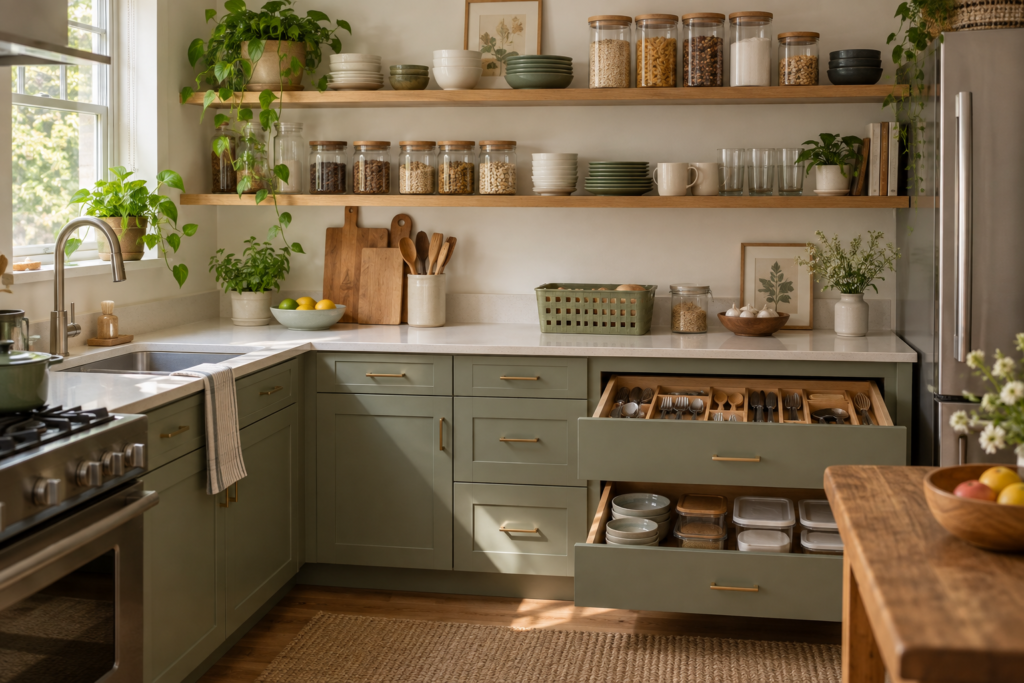
For kitchen shelf riser options, choose a kitchen shelf riser by the storage problem it needs to solve. A fixed riser suits a stable group of dishes, an expandable version can accommodate variable cupboard width, and an approved stacking system can create more levels where cabinet height permits. Compare the space between the legs and the space above and below the platform, then test whether your actual dishes can be removed comfortably.
Shelf risers are sold as a simple way to double cabinet storage, but an extra surface does not automatically double useful capacity. The frame occupies width, its platform uses height, and the new upper level may be harder to reach. A good choice creates two practical storage positions without turning a normal cupboard routine into a puzzle.
This is a comparison of organizer types and buying criteria, not a ranked list of products we have tested. It helps you decide what information to request from a retailer and when to keep an ordinary shelf. For measuring instructions, read the shelf-riser setup guide. If you already own a frustrating riser, start with common shelf-riser problems and fixes before replacing it.
Start with a job description, not a product style
Write one sentence describing the intended change. You might want to separate dinner plates from cereal bowls, keep two mug sizes visible, or use empty height above a row of short jars. These are different jobs. A wide platform that holds bowls well may have legs too close together for your dinner plates, while a deep platform may hide the spice jars it was meant to reveal.
Choose the two groups that will occupy the new levels before shopping. Measure their normal amounts rather than a staged selection. A household with twelve dinner plates needs to test the regular stack, not the three plates visible in a photograph. Include the pieces returned after a dishwasher cycle, when the cupboard is at its fullest.
It is also reasonable to choose no riser. If the cabinet barely fits the height of the objects already inside, adding a platform will not help. Moving an adjustable shelf, reducing duplicates or relocating occasional serving pieces may solve the problem without buying a new accessory. See the kitchen organization hub for related layout decisions.
Compare the main shelf-riser formats
| Format | Useful when | What to verify | Main compromise |
|---|---|---|---|
| Fixed freestanding riser | Dish groups and cabinet dimensions stay consistent | Internal leg gap and lower clearance | Cannot adapt its width |
| Expandable riser | You need flexibility across a wider shelf | Supported extension range and platform overlap | Moving parts or overlaps may affect use |
| Approved stackable system | A tall cabinet needs several short-item levels | Compatible pieces and stacking instructions | Upper access becomes more demanding |
| Corner riser | A corner holds grouped dishes | Depth, corner shape and retrieval path | Back positions may be awkward |
| Under-shelf hanging basket | Light, shallow items need a separate zone | Shelf thickness, door clearance and attachment fit | It reduces space below the original shelf |
Fixed risers: simple dimensions, specific assignments
A fixed riser has a set width, depth and height. That makes it relatively straightforward to measure and evaluate. It is a sensible starting point when you want one additional level for a predictable collection, such as cereal bowls over side plates. The limitation is equally clear: if the internal gap is wrong, the frame cannot become wider simply because the cabinet has spare room.
Pay particular attention to supports that angle inward. The advertised width may describe the platform edge, while the space available to a plate stack is much smaller. A product drawing showing internal measurements is more helpful than a lifestyle image. If that drawing is absent, ask for the measurement rather than estimating from the photograph.
A partial-width fixed riser can leave an open area for tall items beside it. This is useful when the cupboard combines mugs, a coffee pot and bowls. A full-width model may seem like better value, but it can remove the only place a tall object fits without relocating it elsewhere.
Expandable risers: flexibility needs clear specifications
Expandable designs usually change width by moving overlapping parts. They can help when the cabinet width falls between common fixed sizes or when you expect the arrangement to change. However, check the manufacturer’s permitted range and setup instructions. A model’s maximum width is not necessarily the width at which your objects will be easiest to store.
Look at the overlap area and platform pattern. Depending on the design, the expanded surface may have a step, double layer or gap that affects small containers. This matters more for narrow jar bases than for broad plates. Product photos taken only in the closed position may not show the surface your items will actually rest on.
Also ask whether the frame can remain secure at the chosen width during ordinary removal and replacement of dishes. Do not assume that expandable means infinitely adjustable or suitable for bridging unrelated shelf sections. The cabinet shelf must still support the complete arrangement, and the manufacturer’s instructions remain the guide to permissible use.
Stackable systems: more levels require more access planning
A stackable system can suit short objects in a tall cupboard, but use only components explicitly intended to work together. There is a difference between compatible interlocking parts and two separate risers that happen to fit on top of one another. Read the stacking arrangement and limits before comparing the total height with your cabinet.
Think about the uppermost object, not just the top platform. A person may reach a shelf surface yet struggle to lift a bowl from it without tilting the bowl awkwardly. If the cabinet is already high, a third level can make everyday storage less accessible. Put the most frequently used pieces where the shortest regular user can retrieve them comfortably.
Stacking also affects how you clean and inspect the arrangement. If removing the bottom unit requires unloading every level, you may postpone that work. For a small collection, two independent risers placed side by side can sometimes be more convenient than a tall stack, provided they fit and leave the necessary retrieval space.
Corner risers and hanging baskets solve different problems
A corner riser often uses the meeting point of two cabinet walls to create stepped storage for plates or bowls. Its shape may suit a particular corner well, but the back position still needs a clear route to the cabinet opening. Check whether one dish group blocks another when both are fully stocked. A compact footprint is useful only if the pieces remain reachable.
Do not confuse a corner riser with a rotating organizer. The riser normally keeps objects stationary, so visibility and reach depend on your body position and the cabinet opening. In a deep or obstructed corner, a different storage assignment may be simpler than trying to fill every centimetre with elevated dishes.
An under-shelf basket hangs beneath an existing shelf instead of standing on the shelf below. It can create a shallow zone for suitable lightweight items, but its attachment needs to match the shelf thickness and door arrangement. Measure the space lost beneath it. A basket that accommodates tea towels may simultaneously prevent a tall container from standing in its usual position.
Solid platforms, wire platforms and surface details
Compare the contact surface with the base of what you intend to store. Small bottles, narrow jars and delicate feet can sit awkwardly across widely spaced wires. Broad dishes may span those openings without difficulty. A solid platform offers continuous contact, but its edges, finish and cleaning requirements still matter.
For either style, look for places that could catch a dish during retrieval: a front rail, raised lip, exposed joint or platform corner. These details do not necessarily make a design unsuitable. They tell you which dimensions to check and which objects to avoid assigning to that position.
Material descriptions alone are not a reliability ranking. “Metal,” “bamboo” or “plastic” does not tell you the thickness, construction quality, permitted load or compatibility with your cupboard. Evaluate the particular product’s documentation and condition. This guide does not assign unverified performance claims to a material category.
The measurements worth taking before checkout
Measure the usable cupboard width between obstructions, its shelf depth, and the height to the next shelf. Then measure the opening and hinge intrusion. These can be narrower or shallower than the empty interior, especially around the front corners. A frame that can sit inside may still be difficult to insert or remove.
Next, measure the intended lower group at its fullest. Include the diameter of plate stacks and the width of handles. Compare this with the gap between the legs rather than the overall riser width. Measure the upper group separately and add the riser’s height to understand the remaining headroom.
Finally, perform a retrieval rehearsal using a cardboard outline or another non-load-bearing measuring aid. Do not use cardboard as a functioning shelf. Its purpose is to help you see where the legs and platform would sit while you move an actual plate or mug through the proposed opening. That rehearsal often reveals an obstruction a ruler misses.
Worked comparison: two apparently similar choices
Suppose your cupboard is 56 cm wide and you want to separate a 25 cm-wide dinner-plate stack from a group of bowls. One candidate is 50 cm wide overall with supports that leave a 23 cm internal gap in the intended position. Another is 32 cm wide overall but leaves a 28 cm internal gap. These are illustrative dimensions, not product specifications.
The first candidate occupies more cupboard width but does not provide the required opening for that plate stack. The smaller candidate may work better if its height and depth also suit the dishes. The example shows why platform width is a poor substitute for internal clearance. More material and a larger footprint do not guarantee a more useful fit.
Now consider a tall jug in the same cupboard. The partial-width option may leave an uncovered strip beside it for the jug, while the wider option forces the jug elsewhere. Compare the entire cupboard arrangement, including what each organizer displaces, before deciding which one provides better value.
Buying checklist for a useful shortlist
Shortlist products only after identifying the required dimensions and format. For each candidate, record the verified overall size, internal clearances, platform construction, assembly method, manufacturer’s limits and return conditions in your market. Note missing information clearly in your own comparison rather than filling gaps with assumptions.
Prices, availability and delivery vary by country and over time. Check the retailer serving your location and confirm that a similarly named listing is actually the same model and size. A product photograph shared across several variants can make a shallow riser look identical to a deeper one. Match the selected variant before placing an order.
The most useful product recommendation states who the design suits and who should skip it. For example, a narrow partial-width riser might suit bowls beside a tall jug but be unsuitable for a wide dinner-plate stack. That limitation is more helpful than an unsupported claim that one organizer is the best choice for every kitchen.
Sources and practical checks
Check how compatible inserts are joined. IKEA VARIERA product guidance specifies supplied screws for its connected arrangement; this does not authorize stacking unrelated risers. Use the assembly instructions for the exact model you own.
Questions about kitchen shelf risers
Which type is best for a small cabinet?
A fixed partial-width riser is worth considering when it preserves a useful open section beside it, but there is no universal winner. Compare the dishes and retrieval path with the internal clearances. A cramped cupboard may work better with fewer objects and no riser.
Is an expandable riser worth paying more for?
Only if the adjustable width solves a real fit problem or a likely future change. If one fixed size already fits your dishes and cabinet comfortably, expansion may add little practical benefit. Inspect the extended platform and documented setup before deciding.
Can a shelf riser hold a microwave or other appliance?
Do not assume a dish organizer is suitable for an appliance. Appliance support, clearance and installation requirements are separate considerations. Use an appropriate product and follow both manufacturers’ instructions rather than judging suitability from footprint alone.
Should I buy matching risers for every cupboard?
Start with one cupboard and evaluate it during ordinary use. Different cabinets hold different objects and have different clearances. Repeating a successful appearance does not guarantee the same useful result in a cupboard containing taller or wider pieces.
What should I check when the organizer arrives?
Confirm that the dimensions and variant match the listing, inspect the components, and assemble it as instructed. Test it empty, then with the intended dishes within the documented limits. Keep packaging and return information until you know both levels remain comfortable to use.